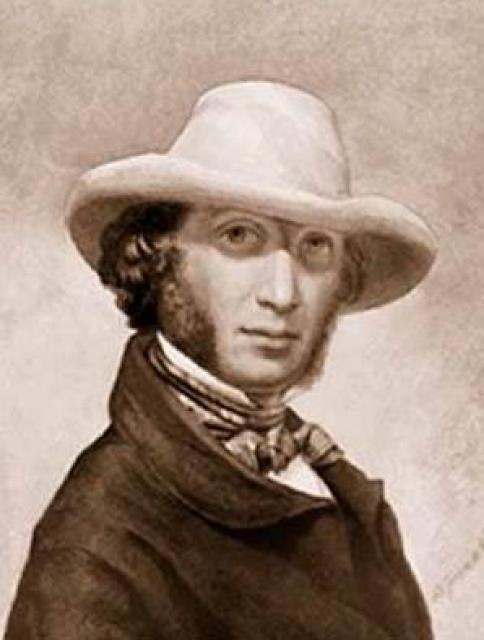
Rafail Eristov
- Raphael Eristavi: Georgian Poet, Dramatist, and Ethnographer
- Social Awareness and Literary Shift
- Emergence of the Folk Poet
- Patriotism and National Identity
- Dramatist and Translator
- Ethnographic Contributions
- Linguistic Studies
- Legacy and Recognition
Raphael Eristavi: Georgian Poet, Dramatist, and Ethnographer
Early Life and InfluencesRaphael Daividovich Eristavi, a Georgian prince, was born in 1824. During his early years, Georgian poetry was dominated by the Anacreontic style. Eristavi's early works reflected this trend, focusing on themes of wine, love, and women.
Social Awareness and Literary Shift
As Russia introduced liberating reforms under Alexander II, Georgian youth grew sympathetic to the plight of the lower classes. This shift influenced Eristavi's literary direction. In 1857, he published "A Mother's Plea to the District Magistrate," addressing the social consequences of serfdom on family life.
Emergence of the Folk Poet
By the late 1870s, Eristavi had established himself as the voice of the Georgian peasantry. His poems, such as "Harvest at Tinia," "The Peasant's Lament," and "Bero's Lament," captured the struggles, aspirations, and rare moments of joy in the lives of ordinary people. These works were infused with empathy and compassion for the suffering of the rural population.
Patriotism and National Identity
A pivotal moment in Eristavi's career was his poem "The Homeland of Khevsur." Its lyrics express a deep attachment to the free life among soaring eagles and cascading waterfalls. The refrain, "I would not trade my rugged cliff for immortality's tree, nor my sacred homeland for foreign paradise," became a national anthem.
Dramatist and Translator
Eristavi also wrote several successful plays for the Georgian stage, including "A Joke with Uncle," "Advocates," and "At the Barber's." As a translator, he rendered into Georgian the works of renowned Russian poets such as Krylov, Pushkin, Lermontov, and Tyutchev.
Ethnographic Contributions
Beyond literature, Eristavi was an avid ethnographer who traveled extensively through the remote regions of the Caucasus. His travels resulted in valuable works such as "On the Tusheti-Pshav-Khevsur District," "Letters from Imereti," and "Travels in Mingrelia."
Linguistic Studies
Eristavi's studies of Georgian dialects and ancient texts formed the basis for his "Georgian-Russian-Latin Dictionary of the Three Kingdoms of Nature." He also edited the Georgian dictionary compiled by the 18th-century writer S.S. Orbeliani.
Legacy and Recognition
A collection of Eristavi's poems was published in Tbilisi in 1893. His works have been translated into multiple languages, including Russian, German, and English. His contributions to Georgian literature and culture have earned him a lasting place in the nation's history.


