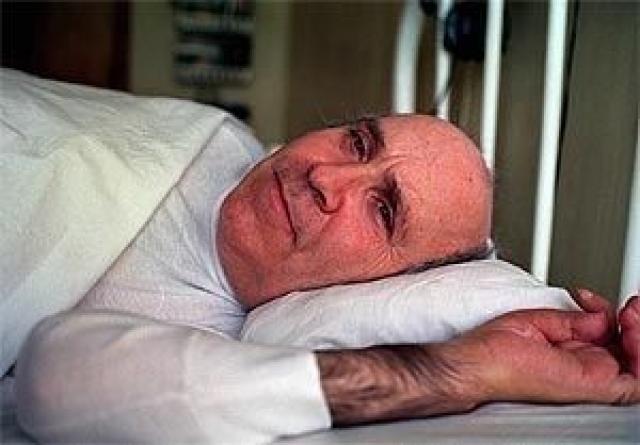
Ramon Sampedro
 Spain
SpainBiography of Ramon Sampedro
Ramon Sampedro was a Galician sailor, poet, and activist who fought for the right to euthanasia. He was born in a fishing town in northern Spain and joined the merchant fleet as a ship mechanic at the age of 19. He wanted to see the world and traveling for free seemed like the best way to do it, as he jokingly said. However, on August 23, 1968, at the age of 25, he had an unfortunate accident when he jumped off a cliff into the sea and broke his spine. As a result of this injury, he was completely paralyzed from the neck down, turning into what he called a "talking head on a dead body."
Doctors diagnosed him with tetraplegia, a paralysis of all four limbs, and gave him a prognosis of only three to four years to live. However, Ramon lived for almost 30 more years, confined to a bed in a farmhouse near the coast and surrounded by the care of his family and friends. Despite his immobility, his mind remained sharp, and he continued to read and write, using a pen held in his teeth. He also made jokes, spoke on the phone, and even worked on a computer using his mouth. He actively engaged with people, but he did not consider this life fulfilling. The spirit of freedom, the thirst for travel and adventure, could not be contained in his immobilized body. It was unbearable for him, as a once strong man, to spend his whole life in a helpless state. He stated in an interview, "The world is worth living, and to be free is wonderful. The tragedy lies in living without freedom."
In the early 1990s, Ramon began his legal battle for the right to die. Euthanasia was illegal in Spain, and assisting someone in committing suicide was punishable by imprisonment. Ramon fought for his right to choose, his right to control his own life. He received support from the Barcelona association "Right to a Dignified Death," which quickly gained followers in Galicia and attracted attention to Ramon's case. He was not an activist for the euthanasia movement, but rather fought for his own right to make decisions about his life.
In April 1993, Ramon appealed to the Civil Court in Barcelona to request that those who assisted him in his suicide not be prosecuted, but his request was denied. On July 18, 1994, the Constitutional Court of Spain rejected his appeal, stating that he should have first sought relief from the territorial jurisdiction court. On May 17, 1995, the European Commission of Human Rights also rejected his complaint, as he had not exhausted all domestic remedies for the protection of his rights. Despite these setbacks, Ramon continued his legal fight.
On July 12, 1995, Ramon filed a lawsuit in the first instance court in Noia, seeking permission for his treating physician to prescribe medications that could allow him to die with dignity, without legal repercussions for the doctor. On October 9, 1995, the court denied his request, citing Article 143 of the Penal Code, which prohibits third parties from assisting in suicide or causing the death of another person.
Ramon appealed the decision. On November 19, 1996, the Provincial Court of A Coruña upheld the decision of the lower court. On December 16, 1996, Ramon registered a complaint with the Constitutional Court, alleging violations of his constitutional rights to human dignity, life, physical and mental integrity, and a fair trial. On March 10, 1997, he was given a 20-day period to submit his final complaints, after which he had to wait for a court date. However, the trial date was never set, and Ramon did not live to see the court's decision.
Even after Ramon's death, his niece Manuela Sanles continued his legal battle. On April 7, 1998, she informed the Constitutional Court that as his heir, she intended to pursue the ongoing proceedings. However, on November 11, 1998, the court dismissed the case, denying her the right to represent her deceased uncle.
Manuela Sanles then appealed to the European Court of Human Rights in Strasbourg, arguing that Ramon's request for assistance in ending his suffering fell within Article 8 (the right to respect for private life) of the European Convention on Human Rights. She also claimed violations of other articles, such as the right to life, freedom and security, freedom of conscience, prohibition of torture, and the right to a fair trial. However, on October 26, 2000, the court rejected her complaint, stating that it does not make abstract decisions regarding the interpretation or application of constitutional provisions, but rather protects individuals from actual violations of their rights. The court also emphasized that complaints can only be brought by the affected individual.
Approximately three months before his death, Ramon was moved from the farm to an apartment in Boiro by his friends, as his family strongly opposed his decision to end his life. On the chosen day, a camera was set up in the room to capture everything that happened. With the help of a straw, Ramon drank water laced with poison. Several of his friends had collected tiny amounts of this cyanide, and he planned everything in such a way that each individual action of his helpers could not be considered as murder. Even Manuela did not know who these friends were; she was merely "his hands," as she described herself.
"There was no turning back," she wrote in her book, "Dear Ramon." "We looked at each other, and I continued to whisper to him. I was relieved, thinking that he would close his eyes and fall asleep. Goodbye, Ramon. But then the convulsions began... I thought it would all happen very quickly, but the agony dragged on..." She admitted that Ramon did not expect this outcome. From his moans, it was clear that this was not the peaceful departure they had hoped for. Nobody knew the exact dosage of the poison. When Ramon's eyes closed, she ran out of the room and covered her ears so as not to hear his moans. She blamed herself for her weakness and wanted to go back and hug him but did not want to disrupt the plan he had meticulously designed over the years.
The next day, Manuela was taken to the police, and she spent two days in custody. However, due to lack of evidence, the case was closed. Although Ramon's family considers her to be his killer, they do not want to pursue legal action.
Ramon's death stirred up the entire Spain and attracted attention from other countries. His funeral, held in his hometown, was attended by many people.
However, his final wish to have his body cremated and his ashes scattered over the sea from the cliff on As Furnas beach, where he had made his fatal leap, was not fulfilled according to his family's decision.