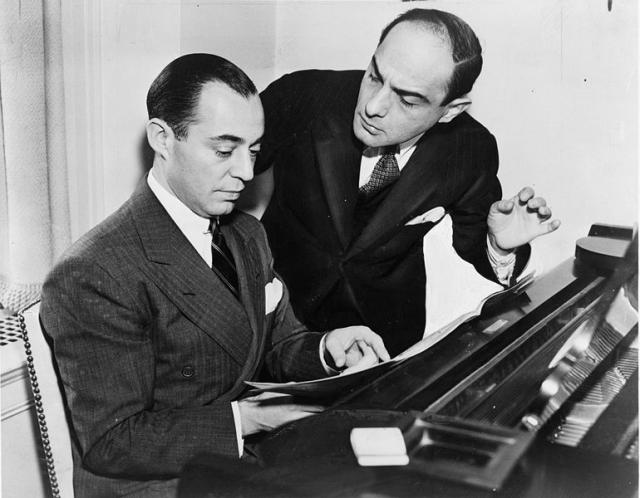
Richard Charles Rodgers
 USA
USA- Richard Charles Rodgers: The Influential American Composer
- Early Life and Education
- Partnership with Lorenz Hart
- Early Success and Collaboration with Oscar Hammerstein II
- The Rodgers and Hammerstein Era
Richard Charles Rodgers: The Influential American Composer
Richard Charles Rodgers was an American composer who wrote music for over 900 songs and 40 Broadway musicals. He also composed music for films and television. He is best known for his collaborations with lyricist Lorenz Hart and Oscar Hammerstein II. His music had a significant impact on American musical culture. Rodgers is one of only two individuals to have ever received an Oscar, Grammy, Emmy, Tony, and Pulitzer Prize.
Early Life and Education
Richard Rodgers was born into a wealthy Jewish family in New York City. He began playing the piano at the age of six. Like his collaborators Lorenz Hart and Oscar Hammerstein II, Rodgers attended Columbia University. His creativity was greatly influenced by the works of Victor Herbert, Jerome Kern, and the operettas his parents took him to see during his childhood.
Partnership with Lorenz Hart
In 1919, Richard Rodgers met lyricist Lorenz Hart. Together, they wrote several amateur musical comedies. Their professional debut was the song "Any Old Place With You," which was featured in the Broadway musical "A Lonely Romeo." Their first professional musical, "Poor Little Ritz Girl," was staged in 1920. Their next professional production, "The Melody Man," premiered in 1924.
Early Success and Collaboration with Oscar Hammerstein II
Rodgers was on the verge of leaving show business when he experienced his first major success. In 1925, their musical "The Garrick Gaieties" was well-received by critics and featured the hit song "Manhattan." Throughout the rest of the decade, Rodgers and Hart created several Broadway and West End musicals, including "Dearest Enemy" (1925), "The Girl Friend" (1926), "Peggy-Ann" (1926), "A Connecticut Yankee" (1927), and "Present Arms" (1928). During the Great Depression, Rodgers and Hart worked in Hollywood, composing songs for films such as "Love Me Tonight" (1932), "The Phantom President" (1932), "Hallelujah, I'm a Bum" (1933), and "Mississippi" (1935).
In 1935, they returned to Broadway and produced a string of popular musicals, interrupted only by Hart's death in 1943. Some of their most notable works include "Jumbo" (1935), "On Your Toes" (1936), "Babes In Arms" (1937), "I Married an Angel" (1938), "The Boys From Syracuse" (1938), "Pal Joey" (1940), and their final collaboration, "By Jupiter" (1942). Due to Hart's health issues, Rodgers was forced to seek another lyricist. Oscar Hammerstein II, with whom they had already co-written several songs, became their new collaborator.
The Rodgers and Hammerstein Era
Their first musical together, "Oklahoma!" (1943), achieved enormous success. Many songs from this musical, such as "Oh, What a Beautiful Morning" and "People Will Say We're in Love," became hits, and the title song became the anthem of the state of Oklahoma. The musical also received the Pulitzer Prize. They went on to create four more renowned musicals, all of which were adapted into films: "Carousel" (1945), "South Pacific" (1949, Pulitzer Prize), "The King and I" (1951), and "The Sound of Music" (1959). They also composed songs for the film "State Fair" (1945).
Overall, Rodgers and Hammerstein's musicals received 35 Tony Awards, 15 Oscars, 2 Pulitzer Prizes, 2 Grammys, and 2 Emmys. Richard Rodgers' contributions to American music continue to be celebrated and cherished.