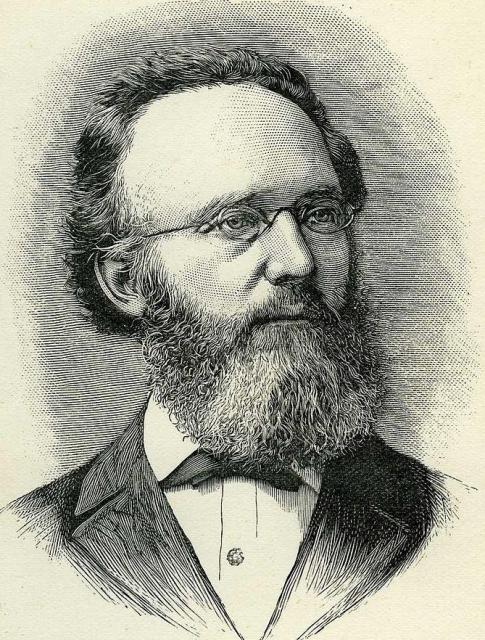
Richard Tangye
 Great Britain
- Biography of Richard Tangye
- Career Beginnings
- Establishing James Tangye and Bros.
- Success with the SS Great Eastern
- Expansion and Innovations
- Birmingham Art Gallery and Birmingham School of Art
- Legacy and Later Years
Biography of Richard Tangye
Early Life and EducationSir Richard Trevithick Tangye was born on November 24, 1833, in Illogan, Cornwall. He was the son of a farmer and grew up working in the fields. However, when he broke his right hand at the age of eight, he was unable to continue manual labor. His father then decided to provide Richard with the best education he could afford. Richard attended Sidcot School, a boarding school where he excelled academically and even gained the privilege to teach.
Career Beginnings
After leaving school, Richard answered an advertisement in the Quakers' newspaper, "The Friend," and secured a position as a clerk in a small engineering firm in Birmingham. His two brothers, who were skilled mechanics, later joined the same company. During his four years of service, Richard not only familiarized himself with all aspects of the engineering business but also suggested shortening the working day on Saturdays, a practice that eventually became common in English industrial enterprises.
Establishing James Tangye and Bros.
In 1856, Richard opened a small business in Birmingham, becoming a sales agent for mining equipment and a commission agent. His first clients were mine owners in the Redruth area. In March 1857, Richard and his brothers James and Joseph transitioned to manufacturing, establishing the company James Tangye and Bros. Their primary product was hydraulic devices, particularly jacks used for lifting heavy objects.
Success with the SS Great Eastern
On January 31, 1858, the Tangye brothers' jacks were successfully used to launch the British steamship SS Great Eastern, designed by Isambard Brunel. Richard famously remarked, "We launched the Great Eastern, and it launched us." This project brought the company considerable recognition.
Expansion and Innovations
In 1859, George Price joined the company, and in 1862, James Tangye invented a new hydraulic jack, leading to further expansion. The company established the Cornwall Works factory and acquired a patent for a new model of direct-acting steam pump in 1867. By 1870, they had begun manufacturing steam engines. The Tangye brothers also secured a contract to develop hydraulic systems for the first British funicular railway in Scarborough, North Yorkshire.
Birmingham Art Gallery and Birmingham School of Art
In 1872, Richard and George became the sole owners of the company. They expanded internationally, opening offices in Johannesburg and Sydney. In addition to their business success, Richard and George were known for their philanthropy. They established the Birmingham Art Gallery in 1885, now home to collections of international importance in painting, ceramics, ironwork, jewelry, archaeology, ethnography, local history, and industrial heritage. They also founded the Birmingham School of Art.
Legacy and Later Years
After Richard's death in 1906 and George's death in 1920, their sons took over the business. In 1919, the company began producing large industrial diesel engines, pumps, and hydraulic equipment. However, after World War II, the focus shifted to hydraulic pumps, valve systems, and other related products. Although the production of engines ceased, the Tangye name and legacy continued to be associated with innovation and engineering excellence.