
Robert Capa
 USA
USA- Robert Capa: The Legendary War Photographer
- Early Life and Career
- Photographing the Horrors of War
- World War II and Beyond
- Capa never commented on this incident.
- Legacy
- Personal Life
Robert Capa: The Legendary War Photographer
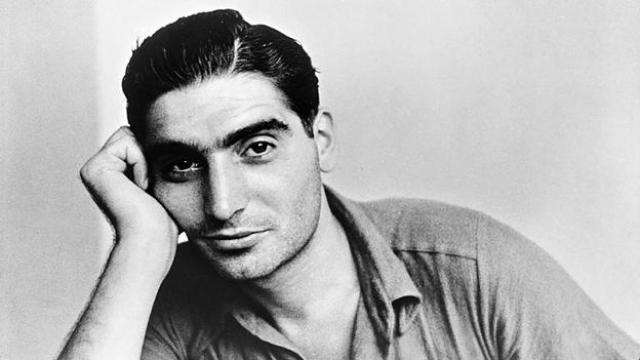
Robert Capa (born Endre Ernő Friedmann) was a renowned photojournalist of Jewish descent. He left behind a legacy of photographs from five wars: the Spanish Civil War, the Second Sino-Japanese War, World War II (European theater of operations – Italy, Normandy; also, London and North Africa), the 1948 Arab-Israeli War, and the first Indochina War. In 1947, Capa became one of the founders of Magnum Photos, the first agency for freelance photographers from around the world.
Early Life and Career
Friedmann was born in the Austro-Hungarian Empire in 1913, when Budapest was one of its major cities. In 1932, he left his hometown after participating in anti-government demonstrations and being arrested. Although Capa had aspirations of becoming a writer, he took up photography after moving to Berlin and soon developed a genuine love for the craft. In 1933, he relocated to Paris as staying in the German capital under Nazi rule became impossible. It was during this time that the name "Robert Capa" emerged. Firstly, it was a memorable name that could help his career as a journalist. Secondly, it had an American sound to it, reminiscent of the famous film director Frank Capra (although in reality, "Capa" means "shark" in Hungarian).

Photographing the Horrors of War
From 1936 to 1939, Capa worked in Spain, capturing the horrors of the civil war. In 1938, he found himself in the Chinese city of Wuhan, documenting the resistance against Japanese aggression. His worldwide fame came with the photograph "Falling Soldier," depicting a Spanish militiaman being shot and falling to his death. There is still debate over whether the image was authentic or staged, as arguments exist on both sides. The exact location of the photograph is also unknown, but it was taken near Sierra Muriana. Regardless, the image remains emotionally powerful. Capa took many photographs in Spain, but when he had to flee Europe in 1939, his collection was lost. It resurfaced in Mexico in the late 1990s and finally found its way to the International Center of Photography in 2007.

World War II and Beyond
With the outbreak of World War II, Capa moved to New York as it was no longer possible to stay in occupied Paris. He photographed the war in various European theaters of operations, working for multiple American publications and news agencies. In 1943, he was in Naples, and in 1944, he was in Normandy, capturing the moment of the Allied invasion.
The photographs he took on D-Day became some of his most famous works. Capa landed with the second wave of assault troops, armed with two "Contax II" cameras with 50-millimeter lenses and several rolls of film. In the first few hours of the operation, he took 106 photographs, but a lab technician from Life magazine made a mistake while developing the film in London and ruined three and a half rolls. Only eight pictures survived out of the 106.
Capa never commented on this incident.
After World War II, Capa traveled to the mysterious Soviet Union with his friend, the famous writer John Steinbeck. They visited Moscow, Kiev, Tbilisi, Batumi, and a still recovering Stalingrad. Steinbeck wrote the reportage book "A Russian Journal" based on their journey, which was illustrated by Capa's photographs. Additionally, Capa traveled through Israel with Irwin Shaw, resulting in another book about the exotic country, with Capa providing the illustrations.
Legacy
In 1947, Capa co-founded Magnum Photos and became its president in 1951. In the early 1950s, he visited Japan for an exhibition related to Magnum Photos. Prior to this trip, Capa had sworn never to photograph wars again, and France was embroiled in the Indochina War. Life magazine offered Capa the opportunity to take a few pictures from the combat zone. However, he did not survive his first assignment in the region.
On May 25, 1954, Capa joined a French infantry regiment along with two journalists from Life magazine. While advancing through a dangerous area under fire, Capa strayed from the group in pursuit of a shot and stepped on a landmine. When he was found, he had lost a leg and sustained a chest wound, but was still alive.
Unfortunately, by the time he reached the hospital, Robert Capa, one of the most famous war photographers, had passed away.
Personal Life
In 1934, Capa met Gerda Taro, a Jewish refugee from Germany. They lived together in Paris, where Friedmann taught Taro the art of photography, and they created the names "Robert Capa" and "Gerda Taro" for themselves. They photographed together in Spain in 1936 and 1937.
It is said that they were engaged, but in 1937, Taro was killed in one of the battles.
Capa was deeply affected by her death and never remarried. However, he had relationships with Elaine Justin, the wife of actor John Austin, from 1943 to 1945 (she left him in 1945), and with actress Ingrid Bergman from 1945 to 1946 (she tried to convince Capa to marry her and settle in Hollywood, but he declined both proposals, and the relationship eventually ended).


