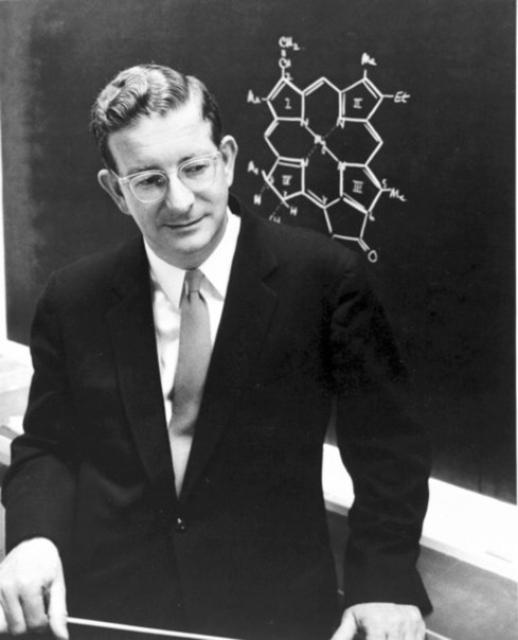
Robert Vudvord
 USA
USABiography of Robert Woodward
Robert Burns Woodward was an American biochemist who was awarded the Nobel Prize in Chemistry in 1965. He was born in Boston, Massachusetts to Margaret (Burns) Woodward and Arthur Chester Woodward. His father passed away a year after his birth. As a child, Woodward spent a lot of time working in his home chemistry laboratory. At the age of 16, he graduated from Quincy High School. Even at that young age, Woodward's remarkable knowledge of organic chemistry set him apart from other students in scientific colleges. In 1933, he received a scholarship to attend the Massachusetts Institute of Technology, where he had the freedom to create his own class schedule. He was also given the opportunity to work in a laboratory on independent hormone research. Woodward obtained his bachelor's degree in 1936 and his doctoral degree in 1937. During the summer semester of 1937, he studied at the University of Illinois and then joined Harvard University as an assistant professor in the Department of Organic Chemistry. He remained at Harvard for his entire scientific career, rising from assistant professor in 1944 to full professor in 1950 (he became an adjunct professor in 1946). He was awarded honorary professorships in 1953 and 1960.
Contributions to Organic Chemistry
Woodward’s first significant contribution to chemistry came when he worked as a consultant for Polaroid Corporation during World War II. The war created a shortage of quinine, a valuable antimalarial drug that is also used in lens manufacturing. Using standard equipment and readily available materials, Woodward and his colleague William E. Doering were able to synthesize quinine for the first time in just 14 months. Woodward’s method involved starting with a simple molecule and, by adding or removing carbon atoms, creating the desired molecule's carbon framework. Then he would "attach" side groups to complete the structure of the desired molecule. In the case of quinine, this process involved 17 transformations to create the carbon structure and many more reactions to reproduce the natural properties of quinine.
Three years later, in collaboration with organic chemist K. G. Schramm, Woodward created a protein analog by linking amino acid chains into a long chain. The resulting polypeptides were used in the production of plastics and synthetic antibiotics and became a valuable tool for studying protein metabolism. In 1951, Woodward led the first research group dedicated to the synthesis of steroids, such as cholesterol and cortisone, which have extremely complex structures. Woodward continued to achieve seemingly impossible syntheses, some of which, such as the synthesis of strychnine, have still not been replicated. Among the compounds he synthesized were chlorophyll, lanosterin, lysergic acid, reserpine, prostaglandin F2a, colchicine, and vitamin B12. Part of this work was conducted at the Woodward Research Institute in Basel, Switzerland, which was established in 1963 by Ciba Corporation (now Ciba-Geigy Corporation). The institute was named after Woodward, who served as its director while also working at Harvard University. Under his guidance, the institute's scientists and staff synthesized many compounds that found industrial applications. One of the most significant compounds was cephalosporin C, a penicillin-like antibiotic used to treat bacterial infections. Woodward died before completing the synthesis of the antibiotic erythromycin.
Advancements in Organic Chemistry
While Woodward is best known for his synthesis work, his contributions to organic chemistry were much broader and more fundamental. When he began his scientific career, the principles of organic chemistry were already well-established. The tetrahedral structure of carbon, the nature of its attached side chains, and their chemical reactivity were known. The analysis of unknown substances was based on classical methods that originated in the 19th century. After breaking down a compound into its components and identifying those components based on the reactions they underwent, conclusions about its structure were made. Woodward revolutionized the application of physical chemistry methods to organic chemistry. He used electron theory to analyze reaction mechanisms and predict the outcomes of reactions, which is crucial in planning organic synthesis. Woodward popularized the use of spectroscopy for faster and more accurate determination of molecular structure. The rule that relates the ultraviolet spectrum, the number, and type of carbon-to-side group bonds is named after him. In collaboration with Roald Hoffmann, Woodward formulated conservation of orbital symmetry rules based on quantum mechanics for concerted chemical reactions (where the formation of chemical bonds occurs during the reaction). This method allowed Woodward to take advantage of natural conditions that facilitate a reaction to obtain the desired molecule.
In 1965, Woodward was awarded the Nobel Prize in Chemistry "for his outstanding achievements in the art of organic synthesis." In his introductory speech on behalf of the Royal Swedish Academy of Sciences, Arne Fredga humorously acknowledged Woodward's supremacy in organic chemistry: "It is sometimes said that organic synthesis is both an exact science and an exquisite art. Here, an indisputable Master is nature. But I dare claim that the laureate of this year's prize, Dr. Woodward, rightly occupies a second place." In 1938, Woodward married Irja Pullman, and they had two daughters. His second wife, Evgenia Müller (whom he married in 1946), worked as a consultant for Polaroid Corporation. They had a son and a daughter. A brilliant and inspiring lecturer, Woodward usually did not use notes or textbooks. Along with Robert Robinson, he founded the organic chemistry journals "Tetrahedron" and "Tetrahedron Letters" and served on their editorial boards. Woodward was also a member of the board of governors of the Weizmann Institute of Science in Israel. A heavy smoker, he enjoyed relaxation through playing football. Woodward died of a heart attack at the age of 62 in his home in Cambridge, Massachusetts.
In addition to the Nobel Prize, Woodward received the George Ledlie Prize from Harvard University (1955), the Davy Medal from the Royal Society of London (1959), the National Medal of Science from the National Science Foundation (1964), the Willard Gibbs Medal from the American Chemical Society (1967), the Lavoisier Medal from the French Chemical Society (1968), the Arthur C. Cope Award from the American Chemical Society (1973), and numerous other awards. He was a member of the National Academy of Sciences and the American Academy of Arts and Sciences, as well as a foreign member of the Royal Society of London and professional societies of many other countries. Woodward received honorary degrees from Yale University, Harvard University, the University of Southern California, the University of Chicago, the University of Cambridge, Columbia University, and many other universities.



