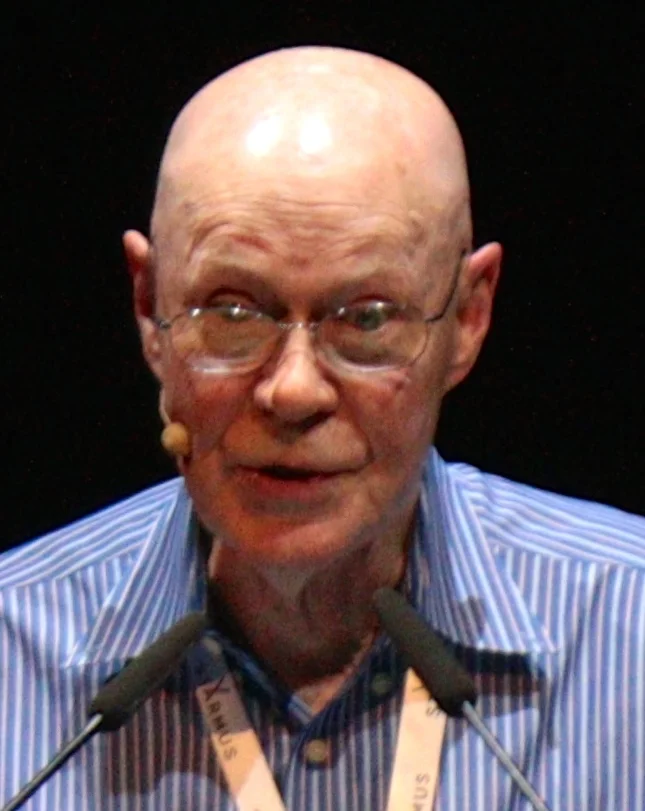
Robert Wilson
Robert Woodrow Wilson is an American astronomer whose work helped transform cosmology. In 1964, while working with Arno Penzias at Bell Laboratories, he detected a faint microwave signal arriving from every direction in the sky. The signal proved to be the cosmic microwave background, relic radiation from the early universe. Their discovery gave powerful support to the Big Bang model and earned them a share of the 1978 Nobel Prize in Physics.
From Houston to Radio Astronomy
Wilson was born in Houston, Texas, on 10 January 1936. He studied physics at Rice University and completed a doctorate at the California Institute of Technology in 1962. He then joined Bell Laboratories in Holmdel, New Jersey, where he worked on radio astronomy and microwave receivers.
At Bell Labs, Wilson and Penzias used a large horn-reflector antenna originally built for satellite communications. Their observations were affected by a persistent background hiss that remained no matter where they pointed the instrument. They carefully checked the equipment and environment, including the antenna’s own surfaces and a roosting population of pigeons, but could not eliminate the signal.
The Cosmic Microwave Background
Wilson and Penzias eventually realized that the unexplained noise was not a flaw in their apparatus. It was cosmic microwave background radiation: a nearly uniform glow left over from the hot early universe, cooled by the expansion of space to a temperature only a few degrees above absolute zero. The signal had been predicted by cosmologists, but the Bell Labs team’s careful measurements provided its first clear detection.
The finding transformed the study of the universe. It strengthened the Big Bang theory in comparison with competing models and opened a new way to investigate the universe’s history and composition. Later measurements by satellites such as COBE mapped tiny variations in the background radiation, revealing further details about the early cosmos.
Wilson and Penzias published their findings in 1965 and shared the 1978 Nobel Prize in Physics for the discovery. Wilson’s Nobel lecture recounted the antenna work and explained how a technical investigation of radio signals led to a result with profound consequences for cosmology.
Beyond the Nobel Discovery
Wilson continued at Bell Laboratories, applying sensitive millimeter-wave techniques to astronomical questions. With Penzias and Keith Jefferts, he helped detect carbon monoxide molecules in interstellar space, enabling astronomers to study cold clouds of gas where stars form. Radio observations of molecular clouds became an important tool for understanding the structure and evolution of the Milky Way.
After his Bell Labs career, Wilson joined the Harvard-Smithsonian Center for Astrophysics, where he continued his scientific work. Across his career, he demonstrated how precise instrumentation and persistent measurement could reveal phenomena far beyond the reach of ordinary observation.
Legacy
Wilson’s work is remembered for a discovery that reshaped a field, but also for the careful experimental practice that made it possible. The microwave background is now one of the most important sources of evidence about the universe’s early stages. By recognizing that an unwanted signal was actually a message from the cosmos, Wilson helped move cosmology toward a more precise, observational science.