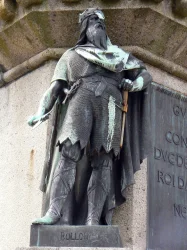
Rollo
Rollo was a Viking leader who made a lasting bargain out of years of raiding and warfare. Around the beginning of the tenth century, he established himself at Rouen in northern France and became the founder of the dynasty that would rule Normandy. His origins and personal life remain obscure, and many of the scenes that made him a larger-than-life hero come from stories written generations later. What is clear is that his settlement helped transform Viking presence in the Seine valley into a durable political power.
A Viking Leader in Francia
Rollo’s name appears in sources with several spellings, including Rou and Rollon; later Norse writers associated him with Hrólfr. Medieval accounts disagree over where he came from. The Norman writer Dudo of Saint-Quentin, writing in the early eleventh century for the ducal family, described him as a Danish exile. Later Scandinavian traditions made him a Norwegian nobleman driven from home. Neither version can be confirmed with confidence, and the details of his youth are uncertain.
By the late ninth and early tenth centuries, Viking bands had repeatedly raided the Frankish lands along the Seine. Rollo emerged as one of the leaders in this unstable frontier. Rather than simply retreat after each campaign, he and his followers established a foothold around Rouen, a strategic city whose river access made it valuable both for trade and for military operations.
The Settlement That Became Normandy
Around 911, Rollo and the West Frankish king Charles the Simple reached an arrangement commonly associated with Saint-Clair-sur-Epte. In the traditional account, Charles recognized Rollo’s control over territory around Rouen in return for his loyalty, baptism, and defense of the region against other Viking forces. No text of the famous treaty survives, and the colorful details come mainly from later Norman histories. Still, the settlement is generally treated as a turning point in the creation of what became Normandy.
The arrangement changed both sides. Rollo’s followers gained a recognized base and began to put down roots; the Frankish king gained a powerful local ally against rival raiders. Rollo’s descendants adopted Christianity and the language and institutions of their new neighbors while maintaining a distinct identity shaped by their Scandinavian origins. The name Normandy itself recalled the “Northmen” who had settled there.
Stories about Rollo’s baptism and marriage reflect this merging of legend and political memory. Dudo describes a marriage to Poppa, the daughter of a local count, and tells of a dramatic ceremony in which Rollo refuses to humble himself before the Frankish king. Such episodes helped later Norman rulers present their founder as both a formidable warrior and a legitimate Christian prince. They are part of the tradition surrounding him, rather than details independently secured by contemporary records.
The First Norman Ruler
Rollo’s son William Longsword succeeded him, extending and consolidating the family’s power. The small territory around Rouen grew over generations into the duchy of Normandy, one of the most influential principalities in medieval Europe. Its descendants would eventually cross the Channel: William the Conqueror, a later member of Rollo’s line, became king of England in 1066.
Rollo himself died sometime in the early tenth century, though the exact date is disputed. His biography remains difficult to separate from the political storytelling of his descendants, but the consequences of his settlement are unmistakable. He stands at the hinge between Viking raiding and Norman rule, a war leader whose descendants turned a hard-won foothold into a powerful European dynasty.