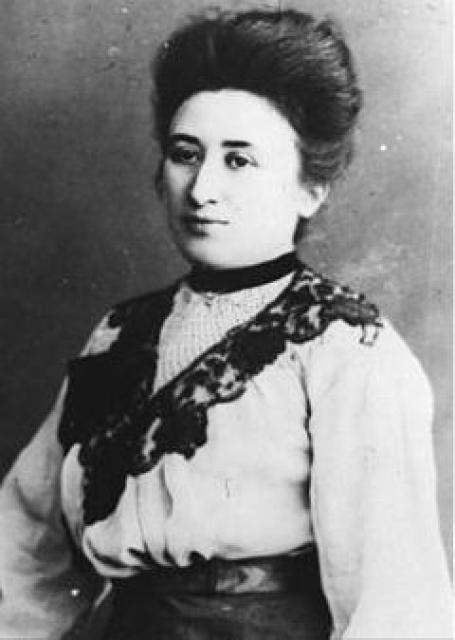
Rosa Luxemburg
 Poland
Biography of Rosa Luxemburg
Rosa Luxemburg was a politician, revolutionary, and activist in the German, Polish, and international labor movement. She was one of the leaders and theorists of the Polish Social Democracy, a left-wing faction within the German Social Democratic Party, and the Second International. Luxemburg was also one of the founders of the Communist Party of Germany.
Early Life and Education
Rosa Luxemburg was born into a bourgeois Jewish family. Even in high school, she actively participated in illegal revolutionary activities, aligning herself with the party. In 1889, she emigrated to Switzerland and completed her university education in Zurich in 1897. During this time, Luxemburg studied Marxist literature and was involved in the activities of Polish political emigrants, laying the foundation for revolutionary social democracy in Poland. She also fought against the nationalism of the Polish Socialist Party.
Political Career
In 1898, Luxemburg moved to Germany and became actively involved in the work of the German Social Democratic Party, positioning herself on its left flank. She strongly opposed the revisionist views of Eduard Bernstein, considering them incompatible with party membership. Luxemburg viewed revisionism as a form of petty-bourgeois reformist ideology and opposed it with revolutionary Marxism. She also actively campaigned against ministerialism and opportunistic compromises with bourgeois parties.
During the Russian Revolution of 1905-07, Luxemburg found common ground with the Bolsheviks on many issues of strategy and tactics. She enthusiastically welcomed the revolution in Russia, considering it an event of immense international significance. Luxemburg participated in the 5th Congress of the Russian Social Democratic Labor Party in 1907, where she aligned herself with the Bolsheviks and recognized the peasantry as a revolutionary class. Drawing from the experience of the Russian Revolution, Luxemburg, along with other representatives of the revolutionary wing of the German Social Democratic Party, criticized parliamentary cretinism and the democratic illusions of reformists. She advocated for the development of extra-parliamentary mass struggle and the inclusion of mass political strikes as a weapon of the proletariat.
Imprisonment and Assassination
In December 1905, Luxemburg illegally traveled to Warsaw and engaged in active revolutionary activities. She was arrested but soon released on bail. She returned to Germany in September 1906 but maintained connections with the Polish labor movement and continued writing for Polish and Russian socialist-democratic press.
Luxemburg faced persecution and repression for her anti-militarist agitation. Throughout her life, she spent approximately four years in prison, mainly during the First World War. Luxemburg recognized the true nature of Kautskyism, an opportunist variety of socialism, and exposed the centrist conciliatory policies of the leaders of the German Social Democratic Party towards the revisionists.
During the outbreak of the imperialist war in 1914, Luxemburg vehemently condemned the chauvinistic policies of the social-democratic leadership. She was one of the founders and leaders of the Spartacus League and authored numerous anti-war leaflets. Luxemburg welcomed the October Socialist Revolution in Russia but disagreed with the tactics employed by the Bolsheviks, such as the dissolution of the Constituent Assembly and their decisions on agrarian and national issues. However, she later embraced Leninism and advocated for the dictatorship of the proletariat and the Soviets in Germany.
Luxemburg was among the founders of the Communist Party of Germany (KPD). At the founding congress of the KPD in December 1918-January 1919, she delivered a report on the party's program. After the suppression of the Berlin uprising in January 1919, Luxemburg was brutally murdered along with Karl Liebknecht.