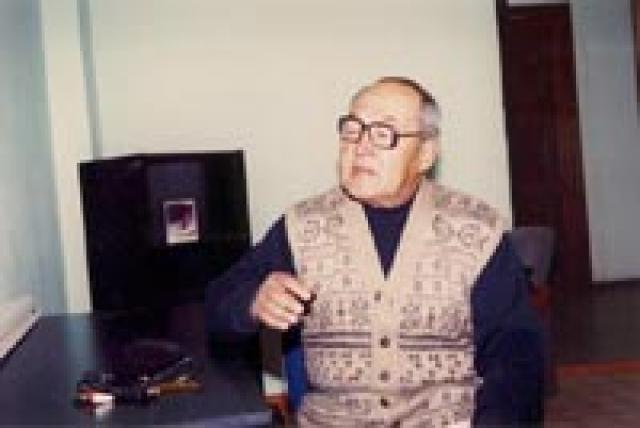
Sabetkazy Akatay
 Kazakhstan
- Early Life and Education
- Involvement in Student Activism
- Academic Career
- Research Focus
- Significance of Worldview Syncretism
Early Life and Education
A prominent Kazakh public figure, scholar, and specialist in the history of philosophy, Akatai was born in the village of Aksaut in the East Kazakhstan Region. He graduated from Moscow State University in 1969 and went on to pursue a postgraduate degree at the Institute of History, Archaeology, and Ethnography named after Ch. Ch. Valikhanov of the Academy of Sciences of the Kazakh SSR in 1973.
Involvement in Student Activism
During his studies in Moscow, Akatai played an active role in establishing and running "Zhas Tulpar," an informal organization for Kazakh students. In the 1960s, it included members of the Kazakh diaspora in Moscow and Leningrad. However, the organization was deemed nationalistic by the authorities, placed under KGB surveillance, and eventually banned.
Academic Career
From 1967 to 1988, Akatai taught philosophy at the Almaty Institute of National Economy and the Almaty Institute of Foreign Languages. He served as rector of the Institute for Advanced Training of Cultural and Art Professionals from 1988 to 1995. Subsequently, he became head of the Department of History and Theory of Culture at the Republican Scientific Center for Cultural Problems of the Ministry of Education, Culture, and Healthcare. Since 1997, he has been a leading research specialist at the Institute of Philosophy of the Ministry of Science and the Academy of Sciences of the Republic of Kazakhstan.
Research Focus
Akatai's primary research interest lies in the " мировоззренческий синкретизм" (worldview syncretism) of the Kazakh people. This refers to the combination of ideas, beliefs, and representations that constitute a people's understanding of the world, humanity, and society. Worldview syncretism can be interpreted as a pre-theoretical form of national social consciousness, a pre-philosophical historical type, or a "religiously-artistic-mythological worldview with its own ontology, anthropology, and demonology."
Significance of Worldview Syncretism
Worldview syncretism developed at the dawn of human civilization as a practical and accessible means of understanding the world. The results of this process were preserved historically and passed down through generations in the form of folk traditions, customs, rituals, norms of behavior, social ideals, and were codified in myths, folklore, and artistic creations. As society evolved, these spiritual achievements became an integral part of the national consciousness and everyday life, shaping cultural uniqueness and ways of perceiving the world.