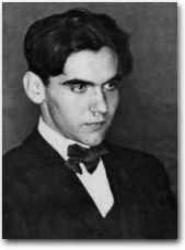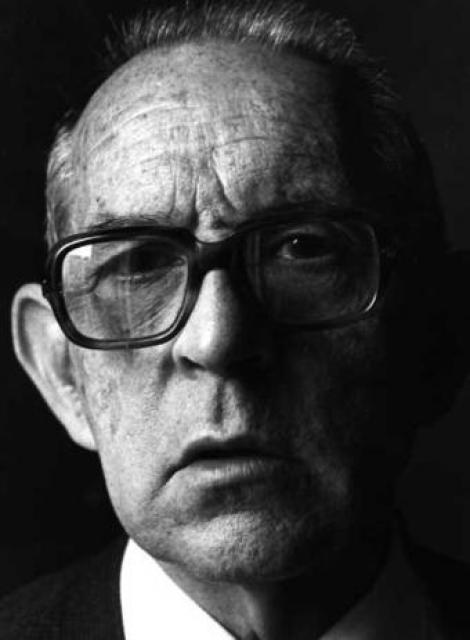
Salvador Espriu
 Spain
SpainBiography of Salvador Espriu
Salvador Espriu was a Catalan poet, novelist, playwright, and writer who primarily worked in the Catalan language. He was born in the coastal town of Arenys de Mar in the province of Barcelona, Catalonia, to a liberal notary father and a deeply religious mother. His entire life was divided between his family's "small homeland" and the cosmopolitan city of Barcelona.
Early Works
Espriu made his literary debut in 1929 with a book of mystic-poetic prose based on the Old Testament called "Israel" (published in Spanish with a small print run of 100 copies, funded by his father). In 1931, he published his first novel in Catalan, "Doctor Rip". While studying law, philosophy, and literature at the Independent University of Barcelona, Espriu traveled to Egypt, Greece, and Palestine in 1933. However, his plans to pursue classical philology and egyptology were disrupted by the Spanish Civil War.
Under Franco's Regime
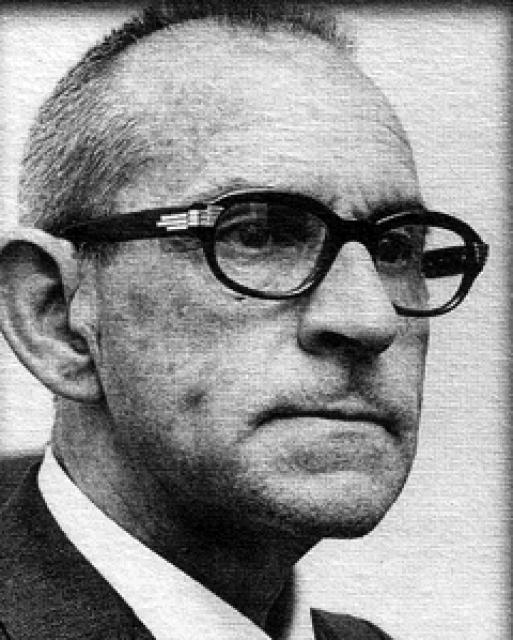
Following the civil and world wars, the university, established during the time of the Spanish Republic, was closed and replaced by the official Francoist regime. The use of the Catalan language was forbidden, and access to higher education was blocked for Espriu and hundreds of thousands of other Catalan intellectuals. For the next twenty years, Espriu worked as a notary's assistant, unable to publish in his native language, and like many others, he was condemned to an underground literary existence.
Major Works
Espriu's major works were influenced by ancient Western and Eastern traditions such as the Egyptian "Book of the Dead," the Bible, ancient Greek tragedies, and mystical Jewish poetry. Simultaneously, his works evolved alongside the search of authors like Kafka, Pessoa, Valle-Inclán, and Pirandello, as well as the Spanish and French existentialist movements. Some of his notable works include the book of short stories "Ariadna in a Grotesque Labyrinth" (1935) and the poetry collections "Cemetery of Sinera" (1946), "Traveler and Wall" (1954), and "Bull's Hide" (1960). He also wrote several dramatic parables, including "Antigone" (1939, published in 1955, performed in 1958), "The First Story of Esther" (1948, performed in 1957), "Phaedra" (1955), and "Another Phaedra, If You Like" (1978).
Recognition and Awards
Espriu's plays and poetry inspired the dramatic composition "Death's Night Watch in Sinera" (1965) by Ricard Salvat, which achieved international recognition throughout Europe. As one of the most prominent figures in contemporary Catalan literature, Espriu was awarded honorary doctorates from the University of Barcelona and the University of Toulouse. He was also a member of the Royal Academy of Fine Arts of Barcelona (1984). Espriu received various accolades, including the Montaigne Prize from the University of Tübingen in Germany (1971), the Catalan Literature Award (1972), the Gold Medal of the Government of Catalonia (1980), the Gold Medal of the City of Barcelona (1982), and the Cross of Alfonso X the Wise (1982), which he declined. He was nominated multiple times for the Nobel Prize in Literature. Espriu's works have been translated into English, French, German, Italian, Spanish, Portuguese, and other languages.