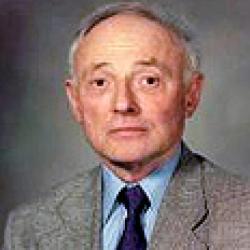
Samuel Karlin
 USA
USA- Early Life and Education
- Influential Research and Career
- Mathematical economics
- Prolific Publications and Recognition
- Academic Legacy
Distinguished Mathematical Legacy: The Life and Contributions of Samuel Karlin
Early Life and Education
Samuel Karlin was born in Janow, Poland, to orthodox Jewish parents. At a young age, the family immigrated to the United States. Karlin's exceptional academic abilities were evident early on. He earned his bachelor's degree from the Illinois Institute of Technology and, at the age of 22, his PhD in mathematics from Princeton University in 1947.
Influential Research and Career
From 1948 to 1956, Karlin worked at the California Institute of Technology (Caltech). Subsequently, he joined the faculty of Stanford University, where he held the prestigious position of professor. During the 1950s, he also contributed to the RAND Corporation's renowned research projects.
Karlin's multifaceted research interests spanned a wide range of mathematical disciplines, including:
Mathematical economics
BioinformaticsGame theory
Evolutionary theory
Mathematical genetics
Biomolecular sequence analysis
Theory of positive matrices
Groundbreaking Collaborations
In the early 1990s, Karlin collaborated with Stephen Altschul to develop the Karlin-Altschul statistic. This breakthrough formed the foundation for the Basic Local Alignment Search Tool (BLAST) algorithms, which have revolutionized biomolecular sequence analysis.
Prolific Publications and Recognition
Throughout his career, Karlin authored approximately 10 monographs and over 450 research articles. His books, including "Total Positivity" and "A Mathematical Approach to Genetic Structure and Selection," have significantly influenced the scientific community and have been translated into Russian.
Academic Legacy
Karlin's son, Kenneth Karlin, has followed in his father's footsteps as a distinguished professor of chemistry at Johns Hopkins University. The numerous awards and honors bestowed upon Karlin throughout his career are a testament to his profound contributions to mathematics and its applications to diverse fields. His legacy continues to inspire and guide the next generation of innovative thinkers.