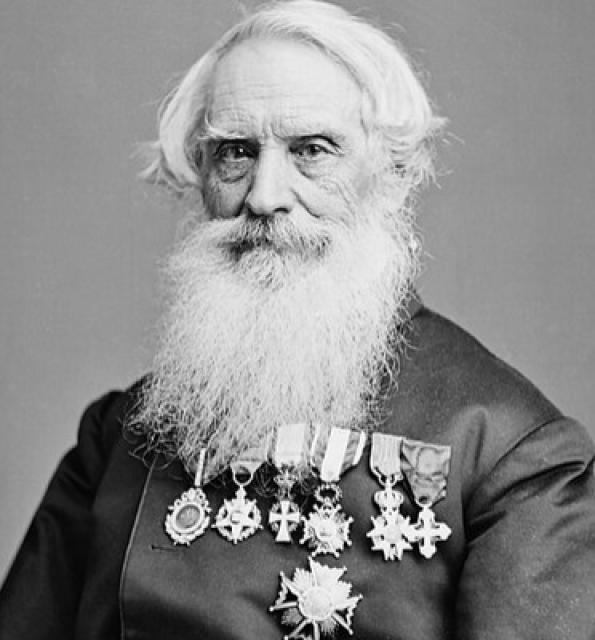
Samyuel Morse
 USA
USA- Samuel F.B. Morse: American Artist and Inventor
- Painting in England and the United States
- Fame in New York and Louvre Gallery Painting
- Disappointment and Turning to Telegraphy
- Invention of the Telegraph
- Commercial Success and Legal Battles
- Legacy and Death
Samuel F.B. Morse: American Artist and Inventor
Early Life and Artistic CareerBorn on April 27, 1791, in Charlestown, Massachusetts, Samuel F.B. Morse began his career in the arts. He studied painting at Yale University and later became a prominent figure in American art during the 19th century. While studying electricity at Yale, Morse developed a passion for electrical experiments.
Painting in England and the United States
In 1811, Morse traveled to England and studied at the Royal Academy of Arts. He also spent time studying in Benjamin West's studio. Returning to the United States in 1815, he hoped to create historical and religious paintings, but struggled to find commissions. He turned to portrait painting, which was popular at the time.
Fame in New York and Louvre Gallery Painting
In 1824, Morse settled in New York City and gained recognition for his portrait of the Marquis de Lafayette. In 1829, he returned to Europe to study the works of old masters. During this time, he conceived the idea of creating a painting that would expose Americans to masterpieces of world art. The result was his famous painting, "The Gallery of the Louvre," depicting numerous miniature reproductions of renowned artworks.
Disappointment and Turning to Telegraphy
Back in America in 1832, Morse's plans for historical paintings were dashed when the commission was awarded to another artist. He accepted a position as Professor of Drawing and Painting at the newly opened New York University. However, his interest shifted to electricity and telegraphy.
Invention of the Telegraph
Inspired by discussions about Faraday's experiments on electromagnetism, Morse devised a way to transmit messages using electrical sparks. During a voyage from Europe, he developed preliminary sketches for an electromagnetic telegraph. Upon his return, he successfully built a telegraph apparatus in 1837. In 1838, he invented the Morse Code for his telegraph and sent the first telegraph message, "What hath God wrought!"
Commercial Success and Legal Battles
Morse's improved telegraph system, developed with physicist Joseph Henry, became widely used in America. He established his own company and spent many years defending the rights to his invention.
Legacy and Death
Samuel F.B. Morse's later life was marked by wealth and fame. He became a philanthropist and died in New York City on April 2, 1872. His legacy as an artist and inventor continued to inspire generations to come.


