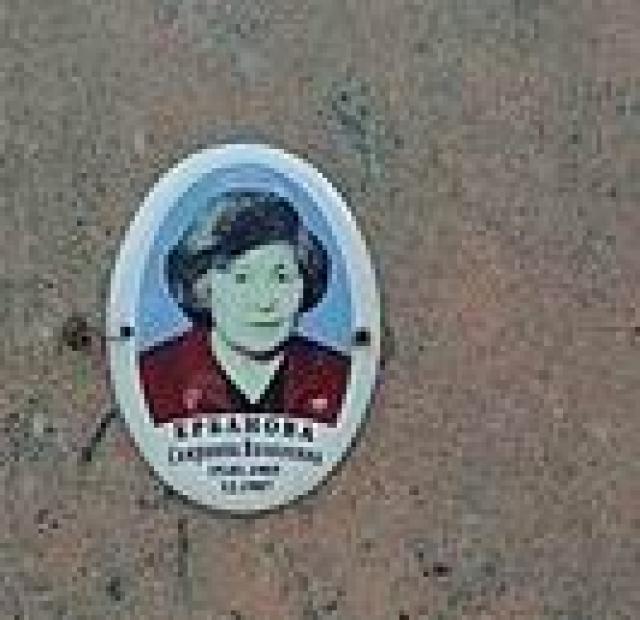
Savranna Erbanova
- Early Life and Education
- Career Beginnings in the Komsomol
- Aginsk and Moscow
- Return to Buryatia and the Great Economic Leap
- Leadership and Recognition
- Purge and Imprisonment
- Rehabilitation and Later Life
- Legacy and Honors
- Savranna received numerous awards and honors, including:
Early Life and Education
Savranna Yakovlevna Yerbanova was born in the village of Zhalgay, Irkutsk Governorate, in a poor family. Her parents, Yakov Malakhirovich and Maria Stepanovna, were both illiterate and followed shamanism. In 1917, Savranna briefly lived with her schoolteacher, Maria Petrovna Bykova, in Nizhneudinsk. She attended Cheremakhovskoye Higher Elementary School, becoming one of the first to join the Komsomol youth organization in 1920.
Career Beginnings in the Komsomol
In 1922, Savranna enrolled in the second year of the economics department at the workers' faculty (rabak) of Irkutsk State University. After completing her studies, she worked for the Komsomol in the Bohan region, where she became a candidate member of the Bolshevik Party (VKP(b)).
Aginsk and Moscow
In 1925, Savranna became the head of the women's department in the Aginsk region. She married Mikhei Nikolaevich Yerbanov that same year. In 1927, the couple moved to Moscow, where Savranna studied economics at the G.V. Plekhanov Institute of National Economy. She later transferred to the G.M. Krzhizhanovsky Moscow Planning Institute.
Return to Buryatia and the Great Economic Leap
In 1932, Savranna returned to the Buryat-Mongol Autonomous Soviet Socialist Republic (BM ASSR) as an economist for the State Planning Commission (Gosplan). She played a key role in the construction of several major enterprises, including a meat processing plant, a glass factory, and a cement plant. She also advocated for the construction of the Buryat State Opera and Ballet Theater.
Leadership and Recognition
In 1936, Savranna became the first woman deputy chairman of the Gosplan in the BM ASSR. She was a prominent figure in the women's movement and a member of the Siberian Bureau of the Komsomol. She received a commemorative gift at a reception in the Kremlin in honor of the BM ASSR.
Purge and Imprisonment
However, Savranna's career took a tragic turn in 1937. She was expelled from the party and arrested on October 14th. Accused of being an enemy of the people, she was imprisoned in the Karlag labor camp, where she worked as a storekeeper.
Rehabilitation and Later Life
In 1946, Savranna was released from the labor camp. She worked as an economist in various regions, including Kazakhstan and the Irkutsk Oblast. In 1954, she sought rehabilitation in Moscow and received a formal apology from the Procurator General of the USSR in 1955.
Savranna returned to Ulan-Ude in 1956, where she was reinstated in the party and resumed her work at the Gosplan. She remained an active member of the community, advocating for the rehabilitation of other victims of Stalinist repression.
Legacy and Honors
Savranna Yakovlevna Yerbanova was a significant figure in the history of Buryatia. She made substantial contributions to the economic and cultural development of the republic. In 1967, she co-authored a book about her husband, Mikhei Yerbanov, who had been executed during the Great Purge.
Savranna received numerous awards and honors, including:
Certificates of Honor from the Presidium of the Supreme Soviet of the Buryat ASSR (1959, 1963, 1967, 1973)
Certificates of Honor from the Buryat Regional Committee of the Communist Party of the Soviet Union (CPSU) and the Council of Ministers of the Buryat ASSR (1973)
Certificates of Honor from the Central Committee of the Komsomol (1968) and the Buryat Regional Committee of the Komsomol (1968)
A Certificate of Honor from the Soviet District Committee of the CPSU in Ulan-Ude (1967)
A congratulatory address and monetary gift from the Buryat Regional Committee of the CPSU and the Soviet District Committee of the CPSU in Ulan-Ude (1976)
A medal "For Valiant Labor" from the Presidium of the Supreme Soviet of the USSR (1970)
A medal "Veteran of Labor" from the Presidium of the Supreme Soviet of the USSR (1975)


