Scopas
Scopas of Paros was one of the leading sculptors of fourth-century BCE Greece, remembered for a style that gave classical figures unusual emotional force. Ancient writers associated him with major monuments from the Peloponnese to Asia Minor, including the Temple of Athena Alea at Tegea and the Mausoleum at Halicarnassus. His life is poorly documented and most works attributed to him have not survived, but fragments and later copies preserve the reputation of an artist who made stone seem intensely alive.
An artist from Paros
Scopas came from the Aegean island of Paros, famed for its fine marble and long sculptural tradition. He was active around 370–330 BCE, though his exact birth and death dates are unknown. Little is recorded about his family or training. Ancient testimony presents him as both an architect and a sculptor, a combination that allowed him to shape not only individual figures but also the buildings and settings that framed them.
The surviving evidence is scattered. Literary descriptions, inscriptions, excavated architectural fragments, and Roman copies all help reconstruct his career, but scholars continue to debate which objects can be confidently assigned to his hand. Scopas is therefore known as much through the artistic character later viewers associated with him as through securely identified originals.
Tegea and the power of expression
One of his best-documented commissions was the Temple of Athena Alea at Tegea in Arcadia. Scopas served as architect and was closely connected with the building’s sculptural program. Its dramatic pedimental figures, known through fragments, show bodies in forceful movement and faces shaped by intense feeling. Rather than the calm balance often associated with fifth-century Greek art, these sculptures suggest struggle, urgency, and psychological strain.
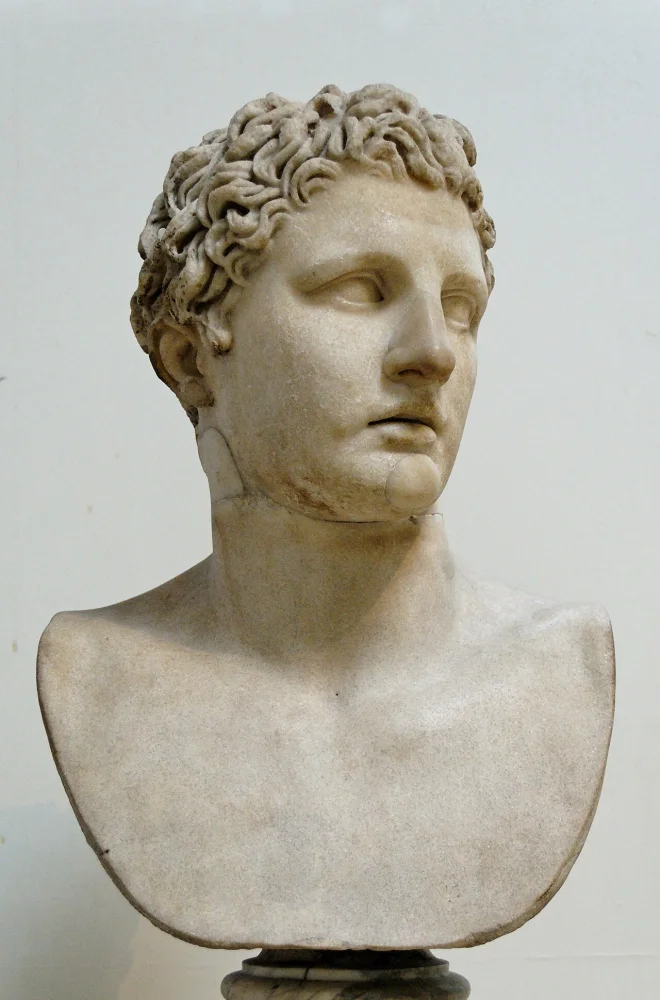
That emotional quality became a hallmark of what later scholars call the “Scopaic” style. Figures attributed to his circle often have deep-set eyes, strongly defined brows, and twisting poses that make inner feeling visible through the body. The label should be used carefully: the style is reconstructed from incomplete evidence, and works once credited directly to Scopas may instead belong to his workshop, followers, or later Roman copyists.
The Mausoleum at Halicarnassus
Scopas also worked on the Mausoleum at Halicarnassus, the monumental tomb of Mausolus, ruler of Caria, and his wife Artemisia. The structure was counted among the Seven Wonders of the Ancient World. Ancient accounts name Scopas alongside Bryaxis, Leochares, and Timotheus as one of the sculptors engaged on its decoration.
The Mausoleum combined architecture, sculpture, and elaborate reliefs on a scale that made it a model for later monumental tombs. Surviving fragments, including portions of its sculptured friezes, offer a glimpse of the ambitious work, though they cannot always be tied to a particular artist. Scopas’ participation placed him at the heart of one of the great artistic collaborations of the classical era.
Legacy
Scopas’ influence extended beyond the monuments he helped create. Ancient authors praised his ability to express pathos, and later artists and critics saw in his work a bridge between the controlled ideals of classical sculpture and the greater movement and emotional intensity of the Hellenistic age. Sculptures such as the Maenad and the Ludovisi Ares have sometimes been connected with his style, although their attribution remains debated.
Because so little of his life is securely known, Scopas can seem more like a signature attached to a group of powerful images than a fully documented person. Yet the surviving fragments from Tegea and Halicarnassus, alongside the ancient descriptions, preserve a clear artistic legacy: he helped expand Greek sculpture’s expressive range, making the human figure convey not only ideal beauty but also passion, tension, and grief.