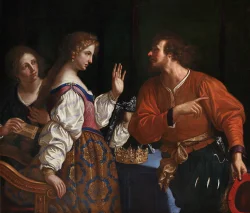
Semiramis
Semiramis became one of antiquity’s most extravagant royal legends: a queen said to have built cities, conquered distant lands, and ruled with the ambition of a king. Greek and Roman writers turned her into a figure of extraordinary beauty and power. Behind the stories may stand an actual Assyrian queen, Sammu-ramat, though the relationship between the historical woman and the legendary heroine remains debated.
The Historical Background
Sammu-ramat was the wife of the Assyrian king Shamshi-Adad V and the mother of Adad-nirari III, who ruled in the early eighth century BCE. Inscriptions identify her as queen and as the king’s mother, and she appears to have held unusual political prominence. Some scholars believe she exercised influence during her son’s early reign, though the evidence does not establish the full extent of her authority.
The Greek name Semiramis is often linked to Sammu-ramat, but the identification is not certain in every detail. The historical record about Sammu-ramat is limited; the much larger biography belongs to the legend that later writers attached to the name.
The Queen of Legend
In Greek accounts, especially those drawing on the lost history of Ctesias and preserved by later authors, Semiramis is associated with Ninus, a legendary king and founder of Nineveh. After his death, she supposedly ruled in her own right and expanded the Assyrian realm through military campaigns.
Writers credited her with founding or rebuilding cities, constructing vast works, and extending power across Asia. Some versions have her lead an unsuccessful expedition into India; others tell that she transformed into a dove after surrendering the throne to her son. These narratives are not reliable records of events, but they reveal how ancient authors imagined a woman who exercised royal power.
Stories of her beauty, sexual conduct, and ambition also became part of the tradition. Such details reflect the conventions and biases of the sources as much as any historical reality. Modern readers distinguish these literary embellishments from the fragmentary evidence for the Assyrian queen.
Legacy
Semiramis endured as a symbol of female sovereignty, ambition, and empire. Ancient writers treated her as an exceptional ruler whose achievements rivaled those of male kings, while later art and literature repeatedly reworked her story. Her name became attached to monumental building projects and legendary feats across the ancient world.
The legend likely preserves a distant echo of Sammu-ramat’s real political visibility, but it cannot be read as a straightforward biography. The historical queen and the mythic conqueror are intertwined in tradition, and the gap between them is part of what has kept Semiramis fascinating for centuries.