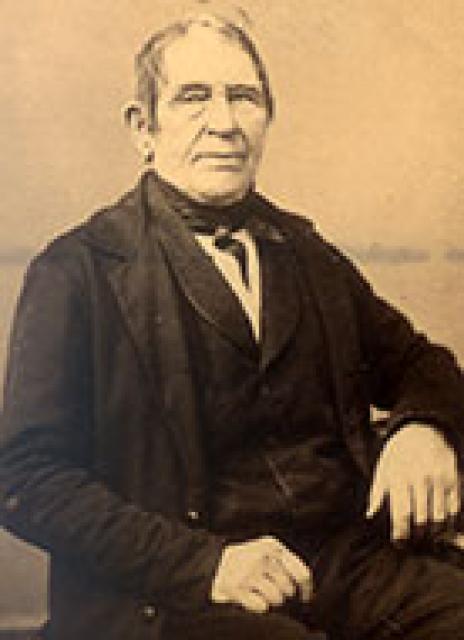
Seth Boyden
 USA
USA- Biography of Seth Boyden
- The Process of Making Patent Leather
- The Invention of Malleable Cast Iron
- Other Inventions and Legacy
Biography of Seth Boyden
Seth Boyden, an American inventor, was born on November 17, 1788, in Foxborough, Massachusetts. He began his career as a master clockmaker before moving to Newark, New Jersey. Boyden's younger brother, Uriah A. Boyden, was also an inventor and engineer.
The Process of Making Patent Leather
In 1818, Boyden came across a piece of German-made patent leather, possibly from a military cap, which caught the attention of local carriage manufacturers. They wanted to know if it was possible to produce such high-quality patent leather in the United States. The German leather looked much better than the American leather used for work boots and other leather goods, while still maintaining its durability. Boyden established a laboratory in the barn of the 'Malleable Cast Iron Foundry of Condit & Bowles,' where he worked, and eventually discovered a way to reproduce the process of making this type of leather. Using his formula, which involved experimenting with leather and linseed oil, local industrialists launched the production of patent leather in September of the following year. The leather quickly gained popularity and became an essential accessory for evening wear. Ironically, Boyden never patented his invention.
The Invention of Malleable Cast Iron
In 1820, at the age of 32, Boyden began working on the formulation of malleable cast iron. Observing the behavior of iron deposited on the walls of his grandfather's blacksmith shop, he developed a theory on the heat treatment of iron. Boyden completed his research in 1826 and received the 'Premium No. 4' from the Franklin Institute in Philadelphia two years later. The Franklin Institute, one of America's oldest scientific educational institutions and museums, recognized that Boyden's malleable cast iron samples, including buckles, bits, and other castings, were smooth and durable. Additionally, this was the first attempt in the country to adapt malleable cast iron for public purposes.
Other Inventions and Legacy
Some sources claim that Boyden also made the first American daguerreotype, a claim that can be found on a memorial plaque at the base of Boyden's statue in Washington Park, Newark. Although the daguerreotype was first demonstrated to the public in New York City in the summer of 1839 by an Englishman named D.W. Seager, it remains a mystery as to which Americans were experimenting with the daguerreotype before this event. Nevertheless, Boyden's camera for daguerreotype is still preserved in the collection of the Newark Museum.
Boyden rarely patented his inventions, preferring to take individual orders and organize and sell established businesses. Although he made a considerable amount of money, it was not enough to finance his research and savings for old age. In his last fifteen years, Boyden lived in poverty in Hilton, New Jersey (now Maplewood), where he cultivated a hybrid strawberry known as the Hilton Strawberry. He passed away on March 31, 1870. The name Seth Boyden is honored by an elementary school in Maplewood, New Jersey, and a public housing complex in Newark.


