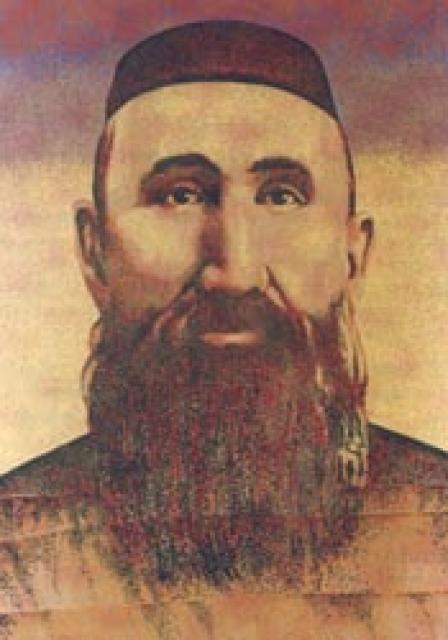
Shakarim Kudaiberdiev
 Kazakhstan
Biography of Shakarim Kudaibergenov
Early Life and EducationShakarim Kudaibergenov, a philosopher, thinker, historian, poet, and spiritual heir of Abai, was born on July 11, 1858, in Ken-bulak of Chingiz volost, Semipalatinsk district (Abay district of Semipalatinsk region), into the Tobikty clan led by Kunanbay, the father of Kudaibergenov's older brother, Abai. His mother, Tolebike, was the daughter of Aldabergen from the Karakesek clan. The writings of Shakarim preserve information and facts about his life and creative activity. At the age of 5, Shakarim's father sent him to study with a local mullah, where he quickly learned Arabic and Persian grammar. Despite losing his father at the age of 7, Shakarim's early childhood and adolescence were carefree, in abundance and contentment, under the patronage of his influential grandfather, Kunanbay. "My late grandfather pitied me as an orphan, so he didn't burden me with studies too much, and as a result, I remained uneducated to some extent, doing whatever came to my mind and growing up without any strictness in terms of upbringing and education," Shakarim recalled later. Abai himself became Shakarim's true mentor, as he was under the care of his grandfather. Shakarim's youth passed in an atmosphere that revered the art of words, science, and education. The aul of Hoji Kunanbay was known for its pursuit of truth, knowledge, and all things progressive. Shakarim was a true student of Abai's school, which revered rhetorical skill, creativity of any kind, and a dedication to music.
Adulthood and Political Involvement
As Shakarim grew up in Semey, he acquired the harmonica, sharmanka, and violin, which he learned to play from a Russian musician. He also engaged in drawing, stone carving, invented and made clothes, made violins and dombra, and raised racing horses while hunting with a golden eagle. It is known that he made a steel prosthesis for a crippled eagle's claw. At the age of 14-15, under Abai's influence, Shakarim started composing poetry. The themes of his philosophical contemplations were nature and ethics, good and evil. "The poems of my youth were passionately revered by young people. But I was unaware of the needs of my people, and therefore, I couldn't say the right words at that time."
However, during that time, Kudaibergenov was unable to fully engage in writing. As soon as he turned 20, he decided to pursue politics in order to help his people achieve a better fate. He tried to organize relationships between clans and different social classes, aiming for peace and prosperity in the steppe. Shakarim offered his candidacy during the elections and was elected as a local leader. Dealing with disputes and conflicts became a school for him. Numerous complaints revealed to him the many injustices in the world around him. He penetrated the system of governance, in which the colonial policy of the Tsarist government, based on the suppression and oppression of the Kazakh people, held a dominant position. The actions of local administrators during this period were unsightly squabbles. On this difficult path, Kudaibergenov repeatedly encountered insurmountable obstacles, experiencing defeat and even doubting the triumph of justice. Reflecting on those years of arduous struggle, he later wrote with great regret:
"Years between twenty and forty,
Irreplaceable youthful years.
They passed in vain,
Filling the heart with festering blood."
Shakarim fully devoted himself to his creativity around 1898, after the age of forty. He began to systematically study Western and Eastern literature. During this time, he acquainted himself with the works of Eastern poets and thinkers such as Hafiz, Fizuli, Navoi, as well as the works of Byron, Pushkin, and Tolstoy. Literature, history, philosophy, music, rhetoric, natural sciences, geography - all were within the circle of his interests. Shakarim independently mastered the Arabic, Persian, Turkish, and Russian languages. Fully dedicated to knowledge and sciences, he embarked on travels to get closer to the people. In 1903, he became a member of the Semipalatinsk subdivision of the Western Siberian Department of the Imperial Russian Geographic Society.
Later Life and Legacy
The beginning of the 20th century marked a period of the rise of Shakarim's creative activity. In 1906, he visited Mecca, Egypt, and Istanbul, worked in libraries, and sent books he acquired by mail to Semey. The last period of his life coincided with the 1905-1907 revolution, Stolypin's reaction, the First World War, the national-liberation movement of 1916 in Kazakhstan, the February and October revolutions, the Civil War, the establishment of Soviet power, and collectivization.
Shakarim witnessed many significant events and changes in the relationship between Russia and Kazakhstan. He participated in the Alash national liberation movement. The establishment of Soviet power in Kazakhstan, the famines of 1920-1921 and 1930-1931, and the mass confiscation in 1928 greatly influenced the poet's worldview. He wrote about the truth of that time:
Condemning me from the outside,
Believing that I belong to the elite of the rich,
Disdaining me and refusing to have soulful conversations,
The young generation runs away from me.
"A rumor among the people: that I have gone mad.
Mullahs claimed that I violated the canons of religion.
Some accused me of glorifying the past, which has passed."
"Now I am left naked before the whole world.
Everyone has moved on, I am alone.
Tell me, my people, where did I go wrong,
And what calamity have I brought to you?
My only companions are a pencil and paper."
In 1912-1922, Shakarim lived in the Kenkonys area, dedicating himself entirely to science and creativity. From 1922, he lived in the village of Shakpan in complete solitude. On October 2, 1931, Shakarim was unjustly convicted and secretly executed. A great talent and a great scholar were forgotten for many years.
During his lifetime, Kudaibergenov's books such as "The Mirror of the Kazakhs," the poems "Kalkaman-Mamyr" and "Enlik-Kebek," were published. Individual poems, articles, essays were published in journals such as "Abai," "Aikap," "Sholpan," and the newspaper "Kazakh" from 1913-1924. "Abai" and "Sholpan" published his translations of Hafiz and the poem "Leyli and Majnun" by Fizuli. His poetic translations of "Dubrovsky" and "The Blizzard" by Pushkin were published in 1936 in Almaty in the magazine "Edebiet Maidany."
Despite the fact that the prosecutor's office of the former USSR rehabilitated Shakarim on December 29, 1958, due to the absence of a crime, the ban on the poet's work, accusing him of "bourgeois nationalism" and other absurd sins, continued. However, the people continued to hold the poet's works in their memory. The Kazakh intelligentsia demanded a reassessment of the official attitude toward Kudaibergenov's work. Only after 1986 did the return of Shakarim's poetry to the people become possible. His activities in organizing the Alash Congress in Semipalatinsk in 1918, articles, philosophical essays, poems, and epics gained publicity. Based on the recordings of Ahat Kudaibergenov (1900-1984), Shakarim's son, a poet and composer, we can shed light on the place of music in the worldview of Abai's spiritual heir. Contrary to the previous approach to Islamism, viewing Abai as something purely condemnable, let alone Shakarim's teachings as pure mysticism, there is a need to objectively look at the continuity between Abai and Shakarim. It was Abai Kunanbayev who drew Shakarim's attention to the East, paid for his expenses to travel to Mecca, Medina, Egypt, and Istanbul, in order to familiarize himself with historical places, scholars, and visit libraries. There, Shakarim acquired valuable books and learned the Eastern system of musical notation. The songs "Zhastyk," "Segiz Ayak," and "Azhalysyz Esker" were composed by Shakarim in collaboration with Abai the composer, who posed the challenge of finding various poetic meters to be combined with the musical melodic sequence. In Shakarim's verses, set to music, fundamental worldview questions were reflected, reminiscent of those posed by Immanuel Kant in his time: "Where do I come from? What should I do? What can I hope for?" As Abai's follower, Shakarim deeply perceived the poetic and musical elements historically formed by the soul of the Kazakh people, and he embodied the layers of beliefs and concepts in them as fundamental principles of his philosophical worldview.


