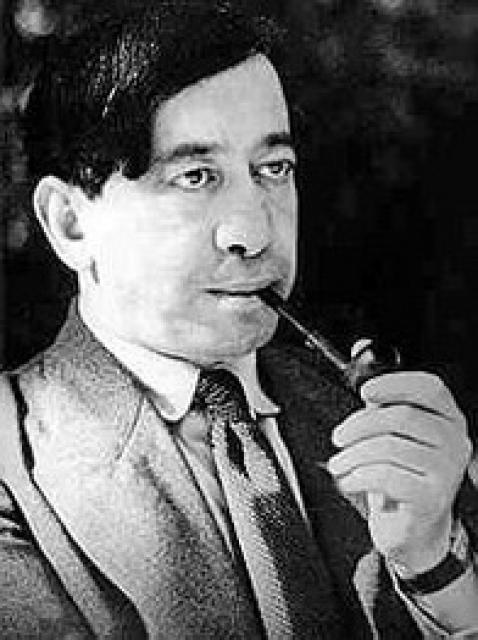
Siegfried Kracauer
 Germany
- Sigfried Kracauer
- Literary and Film Criticism
- Cultural Observation and the "Mass Man"
- Emigration and Work in the US
- Film Analysis and German Cinema
- Later Work and Legacy
- Recognition and Documentary Film
Sigfried Kracauer
Early Life and EducationSiegfried Kracauer was born in Frankfurt am Main, Germany, to a Jewish family. From 1907 to 1913, he studied architecture in Darmstadt, Berlin, and Munich, while simultaneously attending philosophy and sociology courses. In 1914, he obtained his engineering diploma and worked as an architect in Osnabrück, Berlin, and Munich until 1920.
Literary and Film Criticism
In 1922, Kracauer began working as a literary and film critic for the "Frankfurter Zeitung" newspaper, first in Frankfurt and then in Berlin from 1930 onwards. During this time, he became acquainted with Walter Benjamin and Ernst Bloch. Kracauer's writings on popular culture, such as his essay "The Detective Novel" (1925) and his series of articles "Ornament of the Mass" (1927), influenced Theodor Adorno's later studies of the authoritarian personality.
Cultural Observation and the "Mass Man"
Kracauer's writings focused on the emergence of the "mass man" and everyday life in 1920s Germany. He analyzed the boredom of urban life and the rise of popular entertainment in this period. His work drew inspiration from Marxist theory, phenomenological philosophy, and the ideas of Max Weber and Georg Simmel.
Emigration and Work in the US
In 1933, Kracauer emigrated to Paris to escape Nazi persecution. There, he worked on a book about Jacques Offenbach and bourgeois Paris, which was published in 1937. After being interned by the French authorities in 1939, he fled to the US in 1940.
Film Analysis and German Cinema
From 1941 to 1943, Kracauer worked at the Museum of Modern Art in New York, where he studied Nazi film propaganda. His most famous work, "From Caligari to Hitler: A Psychological History of the German Film" (1947), traces the development of fascist ideology in German Expressionist cinema and explores the theme of "man and power."
Later Work and Legacy
In 1960, Kracauer published his monograph "Theory of Film," which became an influential work in film theory and the history of spectacle. Towards the end of his life, he directed research on the impact of mass media on public opinion in socialist countries. Kracauer's posthumously published work, "History, the Last Things Before the Last," reflects his interest in cultural history and the end of time.
Recognition and Documentary Film
Kracauer's work has been acclaimed for its insights into mass culture, film, and the dynamics of society. A documentary film about his life and work, entitled "Looking at the Obvious" (1986), was directed by Rainer Otte and Ralph Egert.


