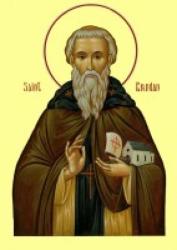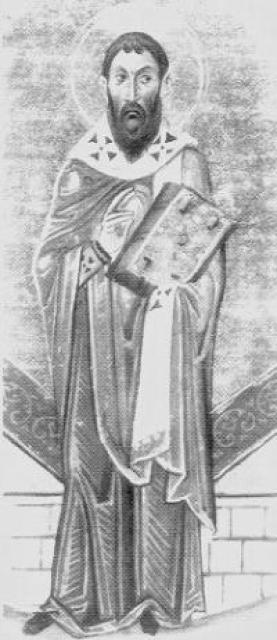
Sofroniy Ierusalimskiy
 Israel
Biography of Sophronius of Jerusalem
Sophronius of Jerusalem, also known as Sophronius the Patriarch, is revered in Orthodox and Catholicism as a saint. In his youth, Sophronius was a teacher of rhetoric. He entered the monastery of Saint Theodosius, where he met and became close with John Moschus. Together, Sophronius and John embarked on a journey to Palestinian and Syrian monasteries. However, their return to Palestine was hindered by the invasion of Khosrow, so Sophronius and John traveled to Alexandria, where they lived for a considerable time under Saint Eulogius and Saint John the Almsgiver. It is likely that during these years they visited monasteries and holy sites in Egypt.
After Alexandria, Sophronius traveled to Rome through Cyprus, where John Moschus passed away around 620 AD. Later, Sophronius had his remains transferred to the monastery of Saint Theodosius. In 630 AD, Sophronius returned to Egypt, where there was an active Monophysite movement. He opposed the Alexandrian patriarch Cyrus. In 634 AD, he was elected to the See of Jerusalem. It was a time of Arab invasions, and shortly after the capture of Jerusalem by Omar in 638 AD, Sophronius passed away.
Sophronius was not an academic theologian; he expressed himself on dogmatic topics as a pastor. Of particular importance is his encyclical, issued upon his assumption of the Jerusalem See, in which Sophronius presents a detailed confession of faith in response to the emerging Monophysite heresy. It was later accepted as an accurate exposition of the faith at the Sixth Ecumenical Council.
Sophronius' encyclical is written in a restrained manner, insisting only on the fundamental dogmas: the Incarnation of the Incorporeal, and the Eternal One accepting birth in time; the true God becoming true man. In the Incarnation, the Word accepts the whole composition of humanity: our flesh, rational soul, mind, all identical to ours. The two natures are united in one hypostasis, clearly recognized as two, and in this union, each retains the fullness of its own properties and characteristics.
From the immutability of the two natures, Sophronius deduces the distinction of two actions (he does not speak of two wills): "We confess both the natural action of each nature and substance, on account of which, for our sake, the indivisible union took place in Christ, making Him one whole God and Son, whom it is necessary to acknowledge as also one whole man." Sophronius attributes both actions to the one Christ due to the indivisible unity of His hypostasis: "And God the Word acts according to the humanity. However, Christ experiences everything human "as a human" and "naturally," albeit not out of necessity or involuntarily." Sophronius emphasizes the phrase "as a human," but without the "passivity" or passiveness that characterizes the "simple," sinful nature of man.
Sophronius is more known for his hagiography and hymnography than his theology. His homilies provide insight into the historical details that allow one to imagine the life of the Church in the conquered Jerusalem.
Sophronius is credited with the famous "Life of Mary of Egypt," which is read in the Orthodox Church during the fifth week of Great Lent, during the service known as "Standing of Mary." He also completed and published the "Spiritual Meadow," the work of his late friend John Moschus. It is difficult to determine his level of involvement in writing this work. He is believed to have composed the praise and accounts of the miracles of the holy healers Cyrus and John (the occasion for the composition was his miraculous healing from an eye disease).
In terms of dogma, his words on the Annunciation are particularly important. Sophronius was a hymnographer, but not all hymns attributed to him can be verified as his own (for example, the hymns attributed to him in the Lenten Triodion do not belong to him). It is believed that he wrote a collection of "anacreontic" poems. These are not liturgical hymns but homilies written in verse form. He is also credited with an explanation of the liturgy, although there is an opinion that this work is not his authorship. It is worth noting Sophronius's work on the church order. It was attributed to him by Simeon of Thessalonica, who credited him with introducing the order of the St. Sabas Monastery for general use in Palestine.