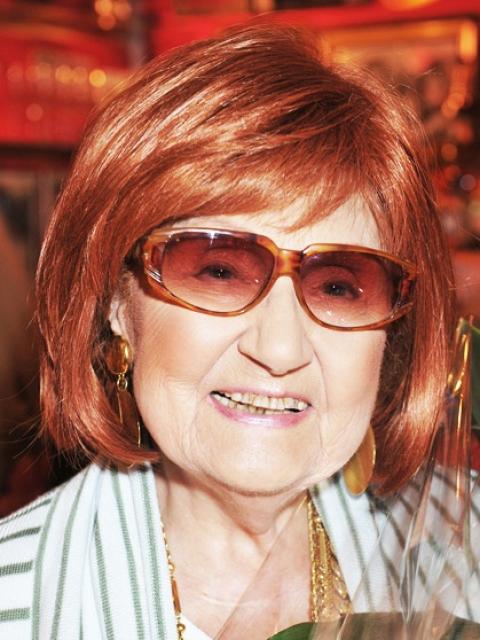
Sonja De Lennart
 Germany
Biography of Sonja de Lennart
Sonja de Lennart, an European fashion designer, is credited with inventing cropped pants in 1948, which became known worldwide as Capri pants. She was born on May 21, 1920, in Prussia, Germany, and was the daughter of a wealthy industrialist.
As a young girl, de Lennart excelled in sports, particularly swimming and track and field. At the age of 8, she had already won several swimming competitions, and in 1932, she participated in the National Youth Competitions as a track and field athlete, running the 100m and 1000m distances. In addition to her athletic pursuits, she was also interested in classical theater and was a talented ballet student at the Breslau State Opera ballet.

While studying in college in Breslau, de Lennart's dream of becoming a fashion designer turned into a passion. Despite strong resistance from her father and the threat of being disinherited, she secretly apprenticed at Erich Boehm's studio and later at Herman Palm's studio in Berlin. There, she honed her skills in cutting, sewing, and tailoring, and learned to create everything from elegant hats to evening gowns, eventually becoming a master of her craft.

After graduating college, de Lennart became a textile engineer. However, the new political regime stripped her family of their wealth. It was through Sonja's talent as a designer that their prosperity returned. In 1945, she began producing fashionable clothing and opened her first boutique, "Salon Sonja," in Munich. Her career in the fashion industry took off when one of her creations, a hand-painted dress, caught the attention of customers at a leading fashion exhibition in Germany. The demand for her designs was so overwhelming that her entire family had to be involved in production, and soon, her form-fitting "second-skin" clothing and three-quarter-length coats became national bestsellers.
In the same year, de Lennart created a collection called the "Capri Collection," which included a bell-shaped skirt with a wide waistband, a high-necked blouse, and a matching hat. She chose this name because her family loved the island of Capri, and she was particularly fond of the song "Isle of Capri."
In 1948, after years of women wearing wide trousers that closely resembled men's attire, de Lennart designed sexy, slim-fitting cropped pants with stylish slits on the outer side of the legs and also named them "Capri." These original classic Capri pants were suitable for both summer and winter. In 1949, German actress Mady Rahl and Austrian actress Erni Mangold posed for de Lennart in summer and winter Capri pants, and this marked the beginning of their tremendous success.
In 1952, influential American costume designer Edith Head was so impressed by de Lennart's revolutionary style and her "Capri Collection" that she used it as inspiration for Audrey Hepburn's wardrobe in the film "Roman Holiday." In 1953, Hubert de Givenchy dressed Audrey in Capri pants for the film "Sabrina." Edith Head introduced the world to Capri skirts, Capri pants, blouses, and belts, but it was the Capri pants that became iconic in the history of fashion.
Among the many celebrities who wore this alluring garment were Katharine Hepburn, Gina Lollobrigida, Ava Gardner, Elizabeth Taylor, Jacqueline Kennedy, Marilyn Monroe, and Sophia Loren. Young women all over the world followed their style icons and made Capri pants a staple in their wardrobe.
In 1955, Sonja opened a much larger Fashion House in Munich and renamed the company "Maison Haase," adding her husband's name. Major film studios, renowned opera directors, costume designers, and celebrities from around the world traveled to Europe to purchase Sonja de Lennart's creations. Ingrid Bergman, Gary Cooper, Maria Schell, Curd Jürgens, Klaus Kinski, as well as prominent ladies from Europe and the East were among her clientele.
De Lennart became one of the most innovative designers in post-war Europe, influencing a whole generation of new fashion designers, and was considered one of the pioneers of the new world alongside Yves Saint Laurent, Paco Rabanne, and André Courrèges. Almost every designer incorporated Capri pants into their collections.