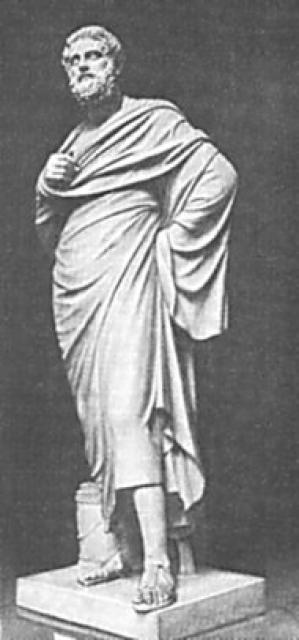
Sophocles
Playwright
Country:  Greece
GreeceBiography of Sophocles
Introduction
Sophocles, the renowned playwright, was not only known for his dramatic works but also held various governmental positions. He served as the treasurer of the state treasury and later became a general, participating with Pericles in the campaign against Samos, which had rebelled against Athens. Sophocles was born around 496 BCE in Colonus, near Athens, and gained fame through his tragedy "Oedipus at Colonus". He passed away in 406 BCE.
Early Life and Education
At the age of 16, in 480 BCE, Sophocles participated in the chorus of ephebes, performing in honor of the victory at Salamis. This fact allowed for comparisons to be made between the biographies of the three great tragedians. Aeschylus had fought in the Battle of Salamis, which Sophocles praised, while Euripides was born during that time. Opinions on his father's social status vary, but he was likely a middle-class individual who provided his son with a good education. Sophocles stood out for his musical abilities and later composed music for the rhythmic parts of his tragedies.
Political Career
In addition to his theatrical achievements, Sophocles held important roles in the Athenian government. His contemporary, the poet Ion of Chios, attested to his participation in the state affairs. In 411 BCE, Sophocles took part in the revision of the Athenian constitution following an anti-democratic coup. He was also known to be a friend of Pericles, and it is believed that the downfall of this prominent political figure influenced his tragedy "Oedipus Rex", which was likely staged around 429 BCE, after the plague that struck Athens.
Works and Achievements
In his tragedies, Sophocles addressed pressing issues of his time. These included the relationship with religion ("Electra"), the divine and unwritten laws versus written laws ("Antigone"), the free will of humans and the will of the gods ("Oedipus Rex", "Trachiniae"), the interests of individuals versus the state ("Philoctetes"), and the problem of honor and nobility ("Ajax"). According to ancient accounts, Sophocles wrote over 120 tragedies, but only seven have survived to this day: "Ajax", "Trachiniae", "Antigone", "Oedipus Rex", "Electra", "Philoctetes", and "Oedipus at Colonus". Additionally, there are substantial fragments of the satyr play "Trackers", inspired by Homer's Hymn to Hermes.
Legacy
The exact dates of the performances of these tragedies cannot be accurately determined. However, it is believed that "Antigone" was staged in 442 BCE, "Oedipus Rex" took place around 429-425 BCE, "Philoctetes" in 409 BCE, and "Oedipus at Colonus" posthumously in 401 BCE. Sophocles achieved his first victory in tragic competitions over Aeschylus in 468 BCE with his trilogy, which included the tragedy "Triptolemus". Plutarch recounts the story of Sophocles being awarded the victory, with the involvement of the Athenian general Kimon and 10 strategoi. In subsequent competitions, Sophocles claimed the first place 20 times without ever ranking third.



