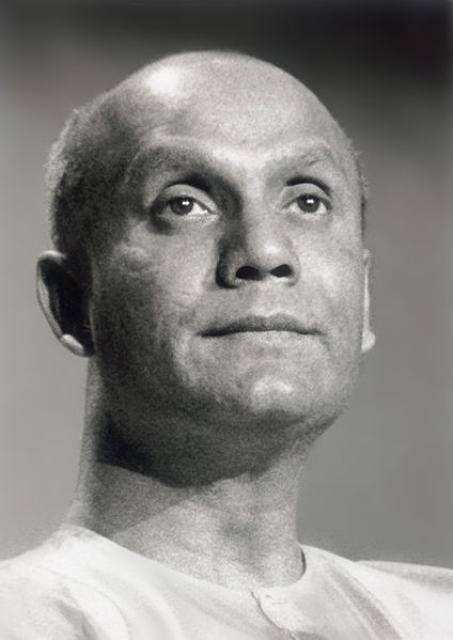
Sri Chinmoy
 India
IndiaBiography of Sri Chinmoy
Early Life in IndiaSri Chinmoy, whose birth name was Chinmoy Kumar Ghose, was born in the village of Shakpura, located in the Chittagong district of Eastern Bengal, India in 1931. He was the youngest of seven children. In 1943, his father passed away from illness, and a few months later, his mother also passed away. In 1944, at the age of 12, Ghose joined his brothers and sisters in the Sri Aurobindo Ashram in Pondicherry, French India. He spent the next 20 years there, studying spiritual practices, particularly meditation. He also worked in cottage industries owned by the ashram, studied Bengali and English literature, and participated in various sports, which was a requirement for Aurobindo's students. According to the ashram's archives, "Chinmoy did work with Nolini (as did many others), but to call him a secretary would be an exaggeration." "He wrote many notes for ashram journals and was an outstanding sportsman."
Life in the USA
In 1964, with the help of American sponsors from the Sri Aurobindo Ashram, Ghose immigrated to New York. His move to America was, according to him, a response to an "inner call" to serve people living in the West who were seeking spiritual growth.
Despite lacking formal education, Chinmoy obtained a position as a junior clerk at the Consulate General of India. He received support and offers from colleagues and supervisors to give lectures on Hinduism. He conducted these lectures at several American universities and later held weekly meditation ceremonies at the United Nations Headquarters for many years. In order to obtain a green card, Chinmoy needed a recommendation confirming his qualification for teaching activities. In one of his books, Chinmoy wrote that he could not request a recommendation from the Aurobindo Ashram as he left without permission. In 1967, this issue was resolved when one of his disciples introduced him to her brother, who worked at the New York branch of the U.S. Immigration Office. The new acquaintance not only waived the requirement for the recommendation but also helped Chinmoy fill out the necessary forms. In the summer of 1967, Chinmoy received his green card.
In 1971, with the support of U Thant, the Secretary-General of the United Nations, Chinmoy began conducting meditations for UN delegates and staff. He referred to the UN as the "engine of universal oneness" and predicted its future role: "The highest role of the United Nations in the spiritual transformation of humanity will be to recognize the importance, necessity, and capacity of spirituality. This is my inner feeling. Spirituality carries the message of peace and tranquility, and it has the capacity to establish peace everywhere in the world. Those who work at the United Nations will eventually come to realize that it is spirituality that will bring harmony, peace, light, and bliss. Spirituality here means the discovery of our inner oneness. If we do not first discover our inner oneness, we can never manifest, reveal, or fulfill our outer oneness through politics or any other means. Spirituality is the foundation. Without a foundation, the house will collapse."
In the USA, Chinmoy led an active creative life. According to his followers, he wrote 1500 books, 115,000 poems, and 25,000 songs in Bengali and English. He created over 200,000 artworks and gave 777 concerts. In 1976, he recorded his first album, "Music for Meditation," under the Folkways Records label. Since then, Chinmoy has released dozens of audio discs featuring his compositions. In 1984, he started a series of free concerts for world harmony. These free performances took place in prestigious venues such as the Royal Albert Hall in London, Carnegie Hall in New York, Nippon Budokan in Tokyo, and the Sydney Opera House.
Apart from his creative pursuits, Chinmoy had a passion for sports at an amateur level. According to his followers, in the 70s and 80s, he participated in 22 marathons (his personal best was 3 hours and 55 minutes in 1979), 5 ultramarathons, and numerous shorter distance races. Chinmoy also competed in tennis events at the Veterans Games, including the World Veterans Games in Puerto Rico in 1983. In the mid-80s, he became interested in weightlifting and initiated the "Lifting Up the World with a Oneness-Heart" awards program. According to his followers, "Lifting Up the World with a Oneness-Heart" is a unique program that recognizes individuals who have achieved outstanding accomplishments in any field, inspiring and uplifting humanity to a new level. The same source claims that "Sri Chinmoy lifted more than 8,300 individuals overhead with one or two arms using a specially constructed platform." In 2006, Russian news agency RIA Novosti reported, based on information from the Sri Chinmoy Centre, that "the founder of the award lifted Russian boxer Nikolai Valuev, the WBA heavyweight champion, a few centimeters off the ground." The report also stated that "legendary champions like Muhammad Ali and Lennox Lewis, Olympic champions Tatyana Lebedeva, Galina Gorokhova, Svetlana Masterkova, and Irina Privalova have passed through the same procedure at different times."
Followers claim that Chinmoy was nominated for the Nobel Peace Prize. One of the asteroids discovered by Crimean astronomers was named after Sri Chinmoy at the initiative of his followers. Its official name is (4429) Chinmoy.
On October 11, 2007, Sri Chinmoy passed away from a heart attack in New York. After his death, his followers installed bronze statues in his honor in several countries, including Oslo, Seattle, Prague, Helsinki, Mazatlán, Vaasa, Bali, Nepal, and Puerto Rico. The statue in the Nepalese village of Nagarkot faces a mountain named after Sri Chinmoy since 1994.



