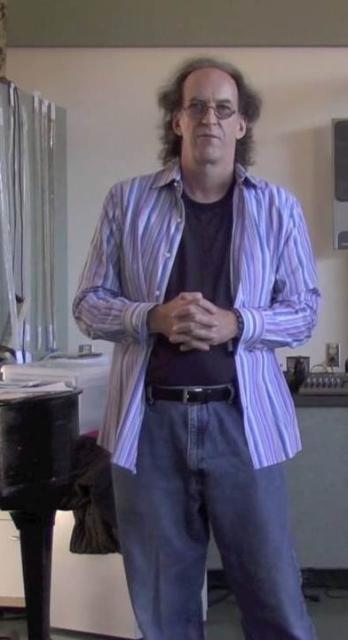
Stanley Jungleib
 USA
USA- Early Life and Education
- Music and Technology
- Synthesizer Development
- Seer Systems and Software Synthesizers
- Challenges and Intellectual Property
- Energy Research and Technology
- Consciousness Research
- Behavioral Kinesiology
Early Life and Education
Stanley Yunglieb (born Stanley Young on May 15, 1953, in San Mateo, California) displayed his aptitude for music, technology, politics, and philosophy at a young age. He played the piano, organ, drums, and orchestral percussion. Concurrently studying philosophy and exploring Judaism, Yunglieb became a conscientious objector to military service. By 1971, Stanley became a protégé of existentialist Peter Koestenbaum and attended San Jose State University, majoring in philosophy.
Yunglieb continued his organ studies with Philip Simpson while also honing his woodworking and electronics skills, apprenticing as an organ builder in Ft. Worth, Texas. This experience provided a solid foundation for his future endeavors in synthesizer design. In 1973, Yunglieb transferred to the University of California, Santa Cruz, where he earned a BA in Philosophy in 1975. His graduate work in philosophy at the University of Rochester was supervised by Richard Taylor and Lewis White Beck.
Music and Technology
As a graduate, Yunglieb held teaching positions in introductory philosophy, modern philosophy, and Eastern philosophy, with an emphasis on Plato, metaphysics, and the philosophy of language. His technical career in Silicon Valley began in 1997 as an instructor at Deterline. As minicomputers and microcomputers emerged at Stanford University and Foothill College, Yunglieb created a publishing division for Chemetrics, a supplier of innovative clinical chemistry kits.
Synthesizer Development
In 1979, Yunglieb joined Sequential Circuits Inc., a prominent synthesizer manufacturer. He became the documentation lead for instruments such as the Prophet-5 and engineered software programs. Stanley's detailed documentation helped make Sequential one of the most sought-after music companies in the 1970s and 1980s. After KORG, a division of Yamaha, acquired Sequential, Yunglieb worked as a product planning specialist, completing the Wavestation synthesizer and designing the Sondius physical modeling software synthesizer.
Seer Systems and Software Synthesizers
While teaching at Cogswell Polytechnical College in 1991, Yunglieb was approached by Intel, a "semiconductor giant," to create a state-of-the-art software synthesizer that pushed the capabilities of personal computers. Initially targeting a digital signal processor (DSP), by mid-1992 the project shifted to the Intel 486. In the early 1990s, Yunglieb founded Seer Systems, which by 1997 had completed development of the world's first commercial software synthesizer. Named Reality, it received Electronic Musician magazine's Editors' Choice Award in 1998. Craig Anderton, a notable figure in the music industry, called Reality "a groundbreaking product."
Challenges and Intellectual Property
By 2000, with legal challenges from disgruntled investors, weak distribution, and piracy, Seer Systems was forced to cease active development, discontinue retail sales, and briefly shift to an online-only sales model. Seer Music Systems, a Canadian company founded by Ian Grant and unrelated to Seer Systems, acquired the distribution rights, continued to offer discontinued Seer Systems products, and provided customer support.
Energy Research and Technology
From 2003 onward, Seer Systems focused on intellectual property protection. In 2005, Yunglieb experienced a shift in his research interests. Conversations with Dr. William Tiller sparked his exploration of Tesla technologies, aura reading, and water structuring. In April 2006, Tiller commissioned Yunglieb to upgrade the electronic devices used in experiments on intentional amplification, or "subtle energies beyond the four fundamental forces." However, as Yunglieb worked on the project, he discovered "fatal flaws" in Tiller's technology that cast doubt on the latter's conclusions.
Consciousness Research
Yunglieb's split with William led to a partnership with Joel Bruce Wallach, creator of Powerforms, which purportedly created an energy field around the body. After several years of subtle energy research, Yunglieb published three research papers supported by the multidisciplinary conference Towards a Science of Consciousness.
Behavioral Kinesiology
From 2006 to 2009, Yunglieb studied and consulted with Dr. John Diamond, the founder of behavioral kinesiology. Through hundreds of kinesiology tests, Stanley gained insights into how to rebalance the life force energy required for optimal and rapid responsiveness to changing realities.




