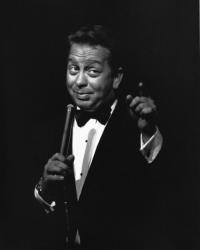
Sten Getz
 USA
USA- Biography of Stan Getz
- Early Career and Rise to Fame
- Later Career and Personal Struggles
- Later Years and Legacy
Biography of Stan Getz
Early Life and CareerStan Getz, whose real name was Stanley Gayetski, was born on February 2, 1927, in Philadelphia, Pennsylvania. He grew up in the Bronx, New York, in a family of Russian (Ukrainian) immigrants. During his school years, Getz learned to play the double bass and cello, performed in the junior-class orchestra, and later switched to the bassoon to become part of the main ensemble. At the age of 12, he began playing the saxophone and started performing at parties and weddings in small ensembles. He was eventually accepted into the All City Orchestra, which consisted of the best local musicians.
Early Career and Rise to Fame
At the age of 15, Getz dropped out of school and joined the Stinky Rogers Dance Orchestra. However, after intervention from the juvenile authorities, he was forced to return to his studies. In 1943, he ran away from home and joined Jack Teagarden's Dixieland band, which was embarking on a country-wide trip. To avoid legal complications, Getz had to be placed under guardianship. Shortly after, he left Teagarden's orchestra to settle in Los Angeles, where he joined Bob Chester's orchestra, which performed at local dance venues. After a month, he joined Dale Jones' Dixieland band.
In 1944, Getz became a member of Stan Kenton's orchestra and participated in various radio programs with him. He also briefly worked with Jimmy Dorsey (1945) and Benny Goodman (1945-46). He married singer Beverly Byrne, sister of Buddy Stewart (vocalist), and performed together with her in Randy Brooks' orchestra. After short engagements with Buddy Morrow's orchestra and Herbie Fields' ensemble (1946), Getz led his own trio in a swing club in Hollywood. He also occasionally played at Potterly's restaurant in the Spanish quarter of Los Angeles with Tony De Carlo's trumpet ensemble, where Beverly Byrne also performed. The core of this ensemble was a quartet of tenor saxophonists formed by arrangers Gene Roland and Jimmy Giuffre, which became known as the Four Brothers (named after a composition written specifically for them by Giuffre). Besides Getz, the section leader, it included Zoot Sims, Herb Stewart, and J. Giuffre. The group was conceived as a "collective solo voice" within the ensemble but could also function as a unique "orchestra within an orchestra" or as an independent improvising combo.
Later Career and Personal Struggles
In 1947, Getz and his "saxophone brothers" caught the attention of Woody Herman, who invited them to join his Second Herd orchestra, which unofficially became known as the Four Brothers Band. The group's lineup changed over time, with Serge Chaloff replacing Giuffre, and then Elmo Kon replacing Herb Stewart. Other musicians, such as Gene Ammons, Bill Perkins, and Richie Kamuca, also played in the band. Getz left Herman's orchestra in 1949 but continued his experiments with saxophone sections in New York, collaborating with Zoot Sims, Elmo Kon, Allen Eager, and Brew Moore. In the same year, he formed his own quartet (with pianist Al Haig, and later with Horace Silver) and toured Sweden in March 1951. Upon returning to the US, he created a new ensemble, a quintet with guitarist Jimmy Raney.
During the 1950s, Getz worked as a studio musician for NBC radio and led various ensembles, including a sextet with trombonist Bob Brookmeyer. However, he struggled with drug addiction, which led to severe depression and an attempted crime (pharmacy robbery). After being arrested, Getz spent several months in treatment and managed to overcome his addiction. He later actively participated in anti-drug campaigns. In 1955, he toured Scandinavia again and performed concerts across the US with his quartet. He also contributed to the soundtrack of the film "The Benny Goodman Story" (1956) and maintained close contacts with Benny Goodman and his orchestra for the following two years. Getz joined the Jazz at the Philharmonic concert series and performed at jazz festivals in Cannes, France, and Knokke, Belgium, where he received great acclaim.
Later Years and Legacy
In late 1958, Getz moved to Copenhagen with his second wife, Monica Getz, a Swedish woman, and lived there for three years while occasionally touring Europe. He participated in the musical score for the French film "Les Tricheurs" (1959) and performed at the International Jazz Festival in Warsaw, Poland (October 1960). After returning to the US in January 1961, Getz resumed performing with his quartet, which now included guitarist Charlie Byrd. Together, they experimented with Latin American samba and bossa nova, pioneering a new direction in contemporary chamber jazz. In the same year, Getz collaborated with Eddie Sauter, who was composing music in the style of the "third stream," combining classical forms with jazz improvisation.
Stan Getz continued to perform and record throughout the 1960s and 1970s, collaborating with various musicians, including João Gilberto, Astrud Gilberto, and Chick Corea. He received critical acclaim and numerous awards for his contributions to the jazz genre. Getz's melodic and lyrical playing style made him a prominent figure in the jazz world, and his recordings remain influential to this day. He passed away on June 6, 1991, in California, leaving behind a rich legacy of music.