Stephen
Stephen, Count of Blois, was a leading noble of northern France and one of the commanders of the First Crusade. He is remembered both for the letters he sent home to his wife, Adela of Normandy, and for leaving the crusading army during the siege of Antioch in 1098. Under pressure to fulfill his vow, he returned east with a later expedition and died in battle in 1102. His family’s story continued through his son Stephen, who eventually became king of England.
A Count in the French Borderlands
Known in some records as Stephen-Henry, he was the son of Theobald III, Count of Blois, and inherited the counties of Blois and Chartres after his father’s death in 1089. These lands lay between the territories of the French king, the dukes of Normandy, and the counts of Anjou, placing their ruler at the center of a competitive political landscape.
Stephen married Adela, daughter of William the Conqueror and Matilda of Flanders. The couple had several children, including William, Theobald, Henry, and Stephen. Adela became an influential political partner: when her husband left on crusade, she governed his lands in his absence.
The First Crusade
In 1096, Stephen joined the First Crusade, traveling east with other major nobles, including Robert Curthose, duke of Normandy. He became one of the expedition’s leading figures. His letters to Adela describe the journey and its major events, offering a rare personal perspective on a campaign usually known through chronicles written after the fact.
The crusading army endured a difficult siege of Antioch, which lasted from 1097 into 1098. Stephen left before the city fell. Accounts suggest that he was ill and believed the crusaders’ situation was hopeless, but his departure was widely regarded as a failure to keep his vow. His reputation suffered further when the Byzantine emperor Alexios I Komnenos encountered him on his retreat and received a bleak report about the crusaders’ prospects.
A Return to the East
Stephen’s wife urged him to return to the Holy Land and repair his standing. In 1101, he joined a new crusading expedition, one of several follow-up forces that attempted to reach Jerusalem. The campaign was disastrous in Anatolia, where Turkish forces ambushed and destroyed much of the crusader army. Stephen survived and eventually reached the eastern Mediterranean.
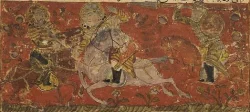
He continued toward the Kingdom of Jerusalem, where King Baldwin I faced renewed military threats. In May 1102, Stephen fought against a Fatimid army in the campaign around Ramla. He was killed during the fighting, probably near Ascalon shortly after the defeat at Ramla. His death came after he had returned to the very region he had left years earlier.
Family and Legacy
Stephen’s career combined a powerful territorial inheritance, crusading leadership, and a conspicuous setback that medieval chroniclers treated as a moral failing. His letters to Adela remain among the most revealing sources for the experiences and hopes of a First Crusade commander. They also point to the trust he placed in her as ruler of their lands while he was away.
His descendants continued to shape European politics. His son Stephen crossed the Channel and became king of England in 1135, beginning a contested reign remembered for civil war with Empress Matilda. The elder Stephen’s own life ended in the eastern Mediterranean, but his family’s influence stretched from Blois to the English crown.