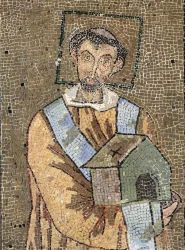
Stephen IX
Stephen IX entered the papacy at a moment when Rome was trying to reshape its relationship with both the German Empire and the Church’s own clergy. Born Frederick of Lorraine, he had been a cardinal, diplomat and abbot before becoming pope in 1057. His pontificate lasted less than eight months, but he strengthened the reform circle that would soon transform medieval church politics.
From Lorraine to Rome
Frederick was born around the beginning of the eleventh century into the ruling house of Lorraine. His father was Gozelo, Duke of Lower Lorraine, and his brother Godfrey became one of the most powerful princes in Italy. The family’s political connections placed Frederick close to the highest levels of European power, but his career would also be shaped by the religious reform movement gathering strength in Rome.
He arrived in Rome during the pontificate of Leo IX, who made him a cardinal and entrusted him with important work in the papal administration. Frederick accompanied Leo on travels and took part in the 1054 embassy to Constantinople, sent to negotiate with the Byzantine Church. The mission became associated with the growing separation between the Latin and Greek churches, although the full part Frederick personally played in the confrontation is difficult to establish.
A monk and abbot
Political tensions surrounding his brother’s conflict with Emperor Henry III made Frederick’s position precarious. In 1055 he withdrew to the Benedictine monastery of Monte Cassino and entered monastic life. After Henry’s death, Frederick was elected abbot of the influential monastery in May 1057. He had moved from the world of imperial diplomacy into one of the most important spiritual centers in western Europe.
That same year, the reform-minded clergy in Rome turned to him after Pope Victor II died. On 2 August 1057, Frederick was elected pope and took the name Stephen IX, after the day’s saint. Some lists number him Stephen X, because an earlier figure called Stephen was elected in 752 but died before his consecration. The Vatican’s official list identifies him as Stephen IX.
A short pontificate with a reform agenda
Stephen’s election took place without the approval of the young German king or his regent, Empress Agnes. That choice signaled a growing determination among reformers to reduce imperial control over papal appointments. Stephen did not simply claim independence in theory: he set about shaping the papal administration around the reform movement.
He promoted Peter Damian, a leading critic of clerical corruption, by making him a cardinal-bishop. He also relied on other reform figures, including Humbert of Silva Candida, and sought to extend reform beyond Rome. Stephen sent a mission to Milan to address the conduct of its clergy and planned to travel to Germany to secure recognition of his election from the imperial regent. His plans show how closely spiritual reform and political independence were intertwined.
The pope also worked to give the reform party a stronger position in Rome and Italy. His family’s influence, particularly that of his brother Godfrey, offered political support, though it also underscored that the papacy remained entangled in the rivalries of powerful nobles. Stephen’s goal was to steer those forces toward a more disciplined church, but his limited time in office left much unfinished.
An untimely end
In late 1057 Stephen travelled to Monte Cassino, where he arranged for Desiderius to succeed him as abbot. He returned to Rome and then went to Florence, where he died on 29 March 1058. His death left the reform movement without its leading figure on the papal throne and immediately reopened the contest over who would control the next election.
The power vacuum was quickly exploited by Roman nobles, who sought to restore their influence over the papacy. Yet Stephen’s brief tenure had helped establish a reforming network of cardinals and clergy that would endure beyond him. He was remembered less for a long list of completed policies than for the direction he gave the office: toward a church less dependent on imperial consent and more determined to reform its own leadership.