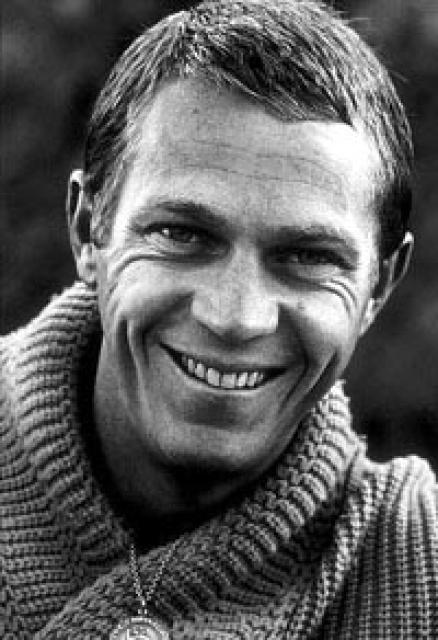
Steve McQueen
 USA
Steve McQueen was an American actor whose quiet intensity, self-reliant screen characters, and love of speed made him one of the defining stars of 1960s and 1970s Hollywood. Nicknamed “the King of Cool,” he became an international leading man through films such as The Magnificent Seven, The Great Escape, Bullitt, and Papillon, while pursuing a parallel passion for motorcycle and car racing.
Early Life and Acting
Born Terence Steven McQueen in Beech Grove, Indiana, on March 24, 1930, he had a turbulent childhood and spent time at the California Junior Boys Republic, a school for troubled boys that he later credited with helping him. At 17, he enlisted in the U.S. Marine Corps, where he served as a tank driver. After leaving the service, he studied acting in New York, including at Sanford Meisner’s Neighborhood Playhouse, and began landing stage and television roles.
McQueen made his Broadway debut in A Hatful of Rain and appeared in the science-fiction film The Blob in 1958. The same year, he became a familiar face as bounty hunter Josh Randall in the television Western Wanted: Dead or Alive. The show established the spare, watchful screen presence that would become his signature.
Hollywood Breakthrough
His film career gathered momentum with John Sturges’s The Magnificent Seven (1960), where his understated performance stood out in an ensemble cast. The Great Escape (1963) further raised his profile, while his work in The Cincinnati Kid (1965) showed a more vulnerable side. In The Sand Pebbles (1966), he played a U.S. Navy engineer aboard a gunboat in China; the performance brought him his only Academy Award nomination, for Best Actor.
In 1968, McQueen starred in The Thomas Crown Affair and Bullitt. The latter became especially famous for its extended car chase through San Francisco, and its cool, controlled detective helped cement McQueen’s image as a modern action hero. Later roles included Junior Bonner, The Getaway, Papillon, and the disaster-film hit The Towering Inferno. His acting style was lean and physical, often conveying tension through pauses, glances, and movement rather than lengthy speeches.
Racing and Life Beyond the Screen
Away from film sets, McQueen was an accomplished motorcycle and car enthusiast who competed in races and collected vehicles. He finished second overall at the 1970 12 Hours of Sebring with co-driver Peter Revson, driving despite a broken foot. His film Le Mans (1971) grew directly from that interest and aimed to bring the texture of endurance racing to the screen. He also appeared in the motorcycle documentary On Any Sunday, which helped introduce the sport to a wider audience.
McQueen married actress and dancer Neile Adams in 1956; they had two children, Terry and Chad, and later divorced. He married actress Ali MacGraw in 1973, and after their divorce, married model Barbara Minty in 1980. His off-screen image—private, restless, and closely tied to cars, motorcycles, and the outdoors—often blurred with the independent characters he played.
Final Years and Legacy
After The Towering Inferno, McQueen took a break from acting and returned with An Enemy of the People in 1978, followed by Tom Horn and The Hunter in 1980. He was diagnosed with pleural mesothelioma and sought treatment in Mexico. He died in Ciudad Juárez on November 7, 1980, aged 50, following surgery.
McQueen’s career was relatively brief, but his most memorable roles left a lasting mark on American popular culture. His blend of vulnerability and toughness, restraint and physical daring, helped define a new kind of movie star—one whose silence could command a scene as powerfully as action.