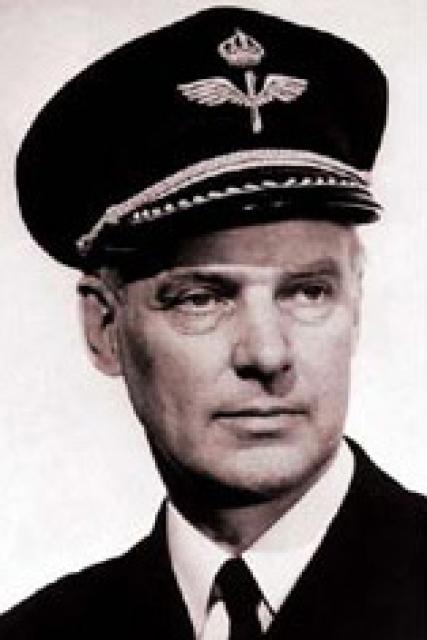
Stig Vennerstrem
 Sweden
- Stig Wennerström: Swedish Cold War Spy
- Early Life and Intelligence Career
- Exposure and Trial
- The Soviet Connection
- Operation "Eagle"
- The DC-3 Incident
Stig Wennerström: Swedish Cold War Spy
Stig Wennerström, the most notorious Swedish spy during the Cold War, passed away at the age of 99. He was sentenced to life imprisonment in 1963 for providing secret information to the USSR, but was released in 1974 for good behavior. The legendary agent, codenamed "Eagle" by Soviet military intelligence, died last week in a Stockholm nursing home, but news of his demise only reached journalists on Tuesday.
Early Life and Intelligence Career
Wennerström, a descendant of an ancient Swedish lineage with distant royal connections, was known for his intelligence, keen observation, and diverse interests. He excelled in photography, competed in car racing, became a Swedish champion in curling, and was adept at water and alpine skiing. He was fluent in eight languages, including Swedish, Norwegian, Danish, German, English, Finnish, Russian, and French.
In 1948, during the early stages of the Cold War, Wennerström was recruited by the Soviet military intelligence agency (GRU). Stationed in the Swedish embassy in Moscow and later in Washington D.C. as a military attaché, he provided information to the GRU for 14 years under the pseudonym "Eagle."
Exposure and Trial
In the early 1960s, Swedish counterintelligence became suspicious of Wennerström. A housekeeper planted in his mansion by counterintelligence operatives eventually led to his exposure. In 1963, he was arrested and, after a year-long investigation, sentenced to life imprisonment for espionage on behalf of the Soviet Union. However, in 1974, Wennerström was pardoned for good behavior. His pardon was also influenced by the fact that his activities had not significantly harmed Sweden, as they were primarily directed against the United States and NATO.
The Soviet Connection
Despite rumors in Western media, Stig Wennerström was never awarded the Order of Lenin. During interrogation under stress, he mentioned the award, which he held a rank as Major General in the Soviet GRU. However, it was more likely "a reflection of his cherished dream," according to Nezavismoe Voyennoe Obozreniye. Wennerström received regular financial compensation from the GRU, part of which was spent on gaining access to alcohol-dependent sources of information.
In the early 1960s, Wennerström traveled incognito to the USSR, where he met with GRU chief General Ivan Serov. The meeting made a lasting impression on the Swede, not only due to Serov's appreciation for his services but also because plans were discussed for Wennerström to continue his activities as a Soviet agent, not in Sweden but in Spain. However, these plans were never realized, as Wennerström was arrested upon his return to his homeland.
Operation "Eagle"
On July 20, 1960, Swedish counterintelligence received information from CIA operative and GRU officer General Polyakov about the existence of a GRU agent codenamed "Eagle" within the Swedish military intelligence. A "trap" was set for "Eagle," and his personal finances were meticulously investigated. He retired on October 1, 1961, and was arrested on June 19, 1963, by Swedish counterintelligence. At the time, he served as an advisor to the Swedish government on disarmament and was a friend of King Gustav Adolf.
SEPO agent Karin Rosen, who was hired as a housekeeper in Wennerström's home, discovered espionage equipment hidden among building materials in the attic of his villa. Upon his arrest, Wennerström confessed to collaborating with Soviet intelligence for 15 years. On July 20, 1964, the Swedish court found him guilty of spying for the USSR and sentenced him to life imprisonment.
The DC-3 Incident
Half a century ago, off the coast of Gotland, a Soviet MiG shot down a Swedish transport plane DC-3, killing all eight crew members. The plane, equipped with advanced American electronic equipment, was used to gather intelligence along the territorial waters of the Soviet Union. The plane's mission was to provide information about Soviet air defense systems in the Baltic region, which was crucial for NATO in the event of a nuclear war.
Stig Wennerström, as "Eagle," informed the GRU of the DC-3's upcoming flight on June 13, 1952. Moscow decided to shoot down the plane, and many years later, Sweden decided to salvage it from the Baltic Sea floor. The plane, covered in silt, was lifted with a giant crane aboard the salvage vessel Belos. Its tail bore the three crowns of the Swedish military aviation. It had lain on the seabed at a depth of 120 meters for almost 52 years.
The DC-3 incident was a relic of the Cold War era, when tensions were at their peak. It strained relations between Sweden and the Soviet Union for decades. While it was widely suspected that the plane was shot down by a Soviet MiG-15, the reasons and details were only revealed much later.
The Swedish government initially claimed that the plane and its occupants disappeared while conducting a training exercise near Gotland. However, the DC-3 was actually engaged in "radio surveillance of new Soviet military bases on the Baltic Sea coast," according to the German publication Frankfurter Rundschau. The operation was conducted using sophisticated British and American equipment under a secret agreement between neutral Sweden and NATO.
The Swedish public was unaware of this, but Moscow was well-informed, thanks in part to Wennerström's status as one of the Kremlin's top agents. The destruction of the Swedish plane was "a crime against international law," approved by Stalin himself, and likely intended as a warning to Sweden to avoid further alignment with the West. Not until 1991 did Moscow acknowledge that the downing of the plane was a "gross violation of international law." Until then, the Soviet Union claimed that the plane had violated its airspace. Rumors circulated that the DC-3 was not shot down but forcibly landed and its crew sent to a Gulag camp in Siberia. Relatives of the crew remained unaware of their fate.
"It was only because my father insured his life that my mother realized that he had been given a dangerous assignment," said Roger Elmeberg, the son of the pilot. He was only three years old when his father died.
Elmeberg later initiated a private expedition that located the wreckage 55 kilometers east of Gotland, near the island Gotka Sandön. At the urging of the victims' families, the government decided to salvage the plane, which had been repeatedly delayed due to technical and weather conditions. Now, the severely damaged fuselage has been recovered. The remains will be transferred to the Muskö Naval Base outside Stockholm for analysis to determine whether all crew members died during the incident. The families hope that this will finally resolve any uncertainties. Video footage of the plane's tail section, riddled with bullet holes, suggests that Soviet Colonel Osinsky, who led the attack, carried it out with deadly precision. "It was like an execution, a shot in the back of the head," said Wilhelm Agrell, a historian who has studied the DC-3 case.


