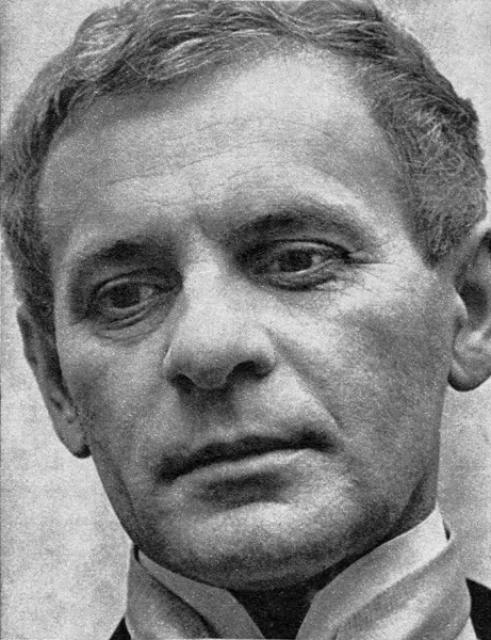
Tadeusz Lomnicki
 Poland
Biography of Tadeusz Łomnicki
Tadeusz Łomnicki was a Polish actor, renowned for his roles in theater and film during his time in Poland. Born on July 18, 1927, in Pohajce near Lviv, he grew up in a family of a postal worker and a schoolteacher. After completing his education in Dembitz, he moved to Krakow, where he worked as a railway worker and studied violin.
During World War II, Łomnicki fought against the Germans as a member of the "Gray Ranks" organization. He later became a soldier in the Home Army. In 1944, when the Red Army entered Krakow, Łomnicki joined the local militia, but left it a year later to pursue his dream of an acting career.
In 1945, he passed the exams to enroll in the Acting School of the Old Theater, one of the most prestigious theaters in Poland at that time. He made his debut in a minor role on the stage of the Old Theater and then played for a short time at the Slovak Theater in Krakow and the Municipal Theater in Katowice. His portrayal of Puck in Shakespeare's "A Midsummer Night's Dream" earned him an award at the Shakespeare Festival in Warsaw.
In 1949, Łomnicki permanently moved to Warsaw and joined the Contemporary Theater, one of the best Polish theaters of that time, led by renowned director Erwin Axer. During this period, he also tried his hand at playwriting, with two of his plays being staged in Kielce and Krakow. He gained the most fame and popularity for his role as Cordian in Juliusz Słowacki's play "Kordian" at the National Theater.
In 1955, Łomnicki had his breakthrough in film, starring in Andrzej Wajda's film "Generation." This film marked Wajda's directorial debut and greatly increased Łomnicki's popularity, establishing him as one of the most prominent actors of the Polish film school. He went on to appear in several acclaimed films by Polish filmmakers, such as Wajda's "Innocent Sorcerers" (1960), Andrzej Munk's "Eroica" (1958), and Czesław Petelski's "Depot of the Dead."
In 1969, he portrayed Michał Wołodyjowski in the films "Colonel Wolodyjowski" and "The Deluge," directed by Jerzy Hoffman. These films were later nominated for an Academy Award in the Best Foreign Language Film category in 1974. Łomnicki continued to act in the Contemporary Theater until 1974, gaining praise for his leading roles in various productions.
From 1970 to 1981, Łomnicki served as the rector of the State Theater School in Warsaw, his alma mater. During his tenure, he introduced new lectures to ensure that graduates were prepared for the changing roles in films and television. He also founded and became the first director of his own theater, Teatr na Woli, in Warsaw. There, he performed in numerous plays, including the role of Goya in Antonio Buero Vallejo's "The Dream of Reason," the lead role in Słowacki's "Fantazja," and the role of Salieri in Peter Shaffer's "Amadeus." He also appeared in several films, including Krzysztof Kieślowski's "The Case," Krzysztof Zanussi's "The Contract," and Andrzej Wajda's "Man of Marble."
However, Łomnicki's popularity began to decline over time. This was partly due to his involvement in the Polish Communist Party, as he was an active member. Although he resigned from all his positions and left the party during the period of martial law in Poland from 1981 to 1983, his reputation never fully recovered. Additionally, in the 1980s, he started experiencing serious health problems and only appeared in minor roles in almost all Warsaw theaters.
Łomnicki was set to play the lead role in Shakespeare's tragedy "King Lear." The premiere was scheduled for February 29, 1992, but a week before the performance, he passed away suddenly from a heart attack during a rehearsal at the New Theater in Poznań. In his honor, the Teatr na Woli in Warsaw was named after him in 1996, and the New Theater in Poznań in 2002.
Throughout his career, Łomnicki received numerous awards and honors, including the Order of the Banner of Work, the Gold Cross of Merit, and several medals for his contributions to Polish culture and education.