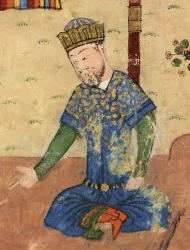
Taksin
- From Ayutthaya official to wartime commander
- The Thonburi king
- Rebuilding and royal authority
- The coup and the disputed final chapter
- Taksin’s legacy
Taksin rose from a provincial official in the kingdom of Ayutthaya to become the ruler who reunited Siam after the Burmese conquest of its old capital. His fifteen-year reign, based at Thonburi, was a period of near-constant war and urgent reconstruction. Remembered as a national hero in Thailand, he remains a striking figure whose achievements were followed by a sudden and still debated end.
From Ayutthaya official to wartime commander
Born in 1734, Taksin was the son of a Chinese immigrant father and a Thai mother. His original name was Sin. He entered royal service in Ayutthaya, where he held administrative posts and developed a reputation as a capable military leader. He was appointed governor of Tak, a western frontier town; the title “Phraya Tak” later became closely associated with his name.
In 1765, Burmese forces invaded Siam and laid siege to Ayutthaya. As the city’s defenses weakened, Sin broke through the encirclement with a contingent of followers and moved east, gathering men and supplies. Ayutthaya fell and was sacked in 1767, leaving the kingdom fragmented among regional warlords and rival centers of power. Sin’s escape gave him a base from which to act at a moment when the old state had collapsed.
The Thonburi king
Sin captured the Burmese-held stronghold at Thonburi and established his headquarters there. By late 1767 he had taken the royal title, becoming known as King Taksin. Thonburi, on the west bank of the Chao Phraya River, offered a defensible position and access to river and maritime trade. The city became the capital of a new Siamese kingdom, while Ayutthaya lay in ruins.
Taksin’s first priority was restoring a central government. Through successive campaigns, he defeated rival leaders and brought much of the former kingdom under his authority by about 1770. He also faced renewed Burmese invasions and led or directed campaigns in the north, northeast, and south. Siamese power extended into neighboring territories, including Lan Na and Lao principalities, while relations with Cambodia repeatedly turned to conflict. The pace of military activity placed heavy demands on the population, but it also prevented the political disintegration that had followed Ayutthaya’s fall.
Rebuilding and royal authority
War did not consume all of Taksin’s attention. His government worked to revive agriculture, trade, and the movement of goods after years of invasion and displacement. Chinese commercial networks helped supply the new capital and the royal treasury. He supported Buddhist institutions and efforts to restore religious life disrupted by the destruction of Ayutthaya. His rule continued many older Siamese practices while adapting them to the realities of a smaller, more mobile capital and a kingdom still recovering from war.
Taksin’s mixed Chinese and Thai background was part of his political identity. He relied on Chinese merchants and officials as well as established Siamese military leaders, building a coalition that differed from the old Ayutthaya court. His success depended on maintaining loyalty among these groups while campaigns and reconstruction strained the new state.
The coup and the disputed final chapter
By the early 1780s, accounts describe growing unrest at court and in the provinces. In 1782, a rebellion broke out while Taksin’s leading general, Chao Phraya Chakri, was away on campaign in Cambodia. Chakri returned, suppressed the revolt, and took the throne as Rama I, founding the Chakri dynasty and establishing a new capital across the river at Bangkok.
The traditional Thai account holds that Taksin was executed in April 1782, soon after his fall. The date and details differ among chronicles, and later accounts have questioned aspects of the story. Claims about the king’s mental state and the precise events around the coup remain difficult to verify. What is clear is that his reign ended abruptly and a new royal house took power.
Taksin’s legacy
Taksin’s lasting achievement was to reunite Siam after the destruction of Ayutthaya and to restore an independent kingdom capable of resisting further invasion. His era was brief and militarized, but it laid the foundation on which Rama I’s new dynasty built. In modern Thailand, Taksin is honored as “the Great,” a title that reflects both the scale of his wartime success and his role in reviving the country after one of its darkest crises.