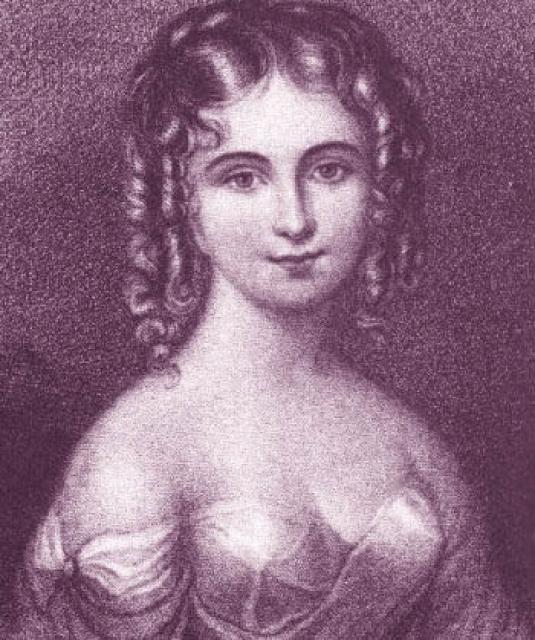
Tereza Gvichioli
 Great Britain
- A Ravenna childhood and an arranged marriage
- A literary and political partnership
- Byron’s departure for Greece
- Memory and legacy
Teresa Gamba Guiccioli is often remembered as Lord Byron’s last great love, but she was more than the muse of a famous poet. A well-educated Italian noblewoman, she moved through the literary and political circles of early nineteenth-century Ravenna, Florence, Pisa and Genoa. Her relationship with Byron brought her into the center of Romantic literary history, while her own memoirs later helped shape how readers understood the poet.
A Ravenna childhood and an arranged marriage
Teresa was born in Ravenna around 1800 to Count Ruggero Gamba and Amalia Macchirelli. The exact date remains uncertain. Her family was part of the local aristocracy, with a history of political involvement that stretched from the Napoleonic period into the liberal and nationalist movements of the nineteenth century. She was educated at the progressive Santa Chiara school in Faenza and later studied with the philologist Paolo Costa, who encouraged her interest in literature.
On 7 March 1818, she married Count Alessandro Guiccioli, a wealthy man more than twice her age. The marriage brought her into the world of aristocratic salons and travel. During the winter of 1818–19, the couple were in Venice, where she met the English poet Lord Byron at a gathering hosted by Countess Marina Querini Benzon.
A literary and political partnership
The meeting sparked an intense relationship. When Teresa returned with her husband to Ravenna in June 1819, she became ill and asked Byron to join her. He arrived soon after, and their association developed amid the rigid expectations surrounding a married woman of her rank. The Guicciolis’ relationship became strained, and in July 1820 a papal decree authorized their separation, requiring Teresa to live with her father or in a convent. Byron, meanwhile, rented rooms at Palazzo Guiccioli and continued to see her.
Teresa was not only a companion to Byron but a bridge to Italian political life. Her father and brother Pietro Gamba were associated with liberal and Carbonari circles, and she and Pietro helped draw the poet toward Italian culture and the cause of national independence. Byron supported the Carbonari with money and arms. Teresa also inspired his interest in Italian literature; *The Prophecy of Dante* was among the works associated with this period.
After leaving Ravenna, Teresa lived with her family and Byron in Pisa, Livorno and Genoa. Their circle included Percy Bysshe Shelley and Mary Shelley. These years brought creative exchange and personal upheaval: Shelley died in 1822, as did Byron’s daughter Allegra, while the political pressure on the Gamba family continued.
Byron’s departure for Greece
Byron decided to join the Greek struggle for independence in 1823. Teresa learned of his plans late and asked to accompany him, but he sailed from Italy on 15 July with her brother Pietro and left her behind. It was the last time she saw him. Byron died in Missolonghi in April 1824, and Teresa received the news while in Bologna.
She remained connected to his memory. In 1847, she married the French nobleman Hilaire-Octave Rouillé, Marquis de Boissy. Years later she published *Lord Byron jugé par les témoins de sa vie* (1868), followed by the English edition *My Recollections of Lord Byron* (1869). The volume gathered recollections and testimony to defend Byron’s character against accounts she considered scandalous. It became an important source for later readers, though it also reflected her personal loyalty and perspective.
Memory and legacy
Teresa Gamba Guiccioli died in Florence in 1873. Her life crossed the intimate world of Romantic literature and the political networks of the Italian Risorgimento. While popular retellings often frame her chiefly as Byron’s lover, she also acted as a cultural intermediary, a participant in an aristocratic family’s liberal circles and the author of a memoir that helped preserve the poet’s image.


