Thecla
Thecla is one of the most celebrated women in early Christian tradition. Known as a follower of the apostle Paul, she became a symbol of spiritual independence, chastity, and courage in the face of persecution. Her story is told not in the New Testament but in the second-century apocryphal Acts of Paul and Thecla, a work that inspired a lasting cult and a rich body of religious art.
The story of Thecla
According to the Acts, Thecla was a young woman from Iconium who heard Paul preach about Christian faith and celibacy. Though engaged to Thamyris, she rejected the marriage arranged for her and chose to follow the teachings she had heard. Her decision angered her family and brought her before local authorities.
The narrative subjects Thecla to repeated threats and public punishments. She is condemned to burn at the stake, but a storm puts out the flames. Later, she is thrown to wild beasts in Antioch and survives a series of attacks. When she sees a pool filled with dangerous animals, she baptizes herself in the name of Jesus. These dramatic scenes present her as both a fearless believer and a woman who claims agency over her own religious life.
Disciple and teacher
In the story, Thecla travels and preaches, eventually reaching Seleucia in Asia Minor. She lives as an ascetic and is associated with healing and teaching. The text portrays her not only as Paul’s disciple but as a missionary in her own right, a striking role in an ancient narrative about women’s place in Christian communities.
The Acts of Paul and Thecla reflects the debates of the early church about marriage, celibacy, authority, and women’s religious leadership. Its claims are not a reliable record of Paul’s travels or a confirmed biography of a first-century woman. Thecla’s historical existence cannot be established from the surviving evidence; scholars generally treat her story as a devotional narrative that may preserve older traditions but was written well after the events it depicts.
A powerful early Christian cult
Although the story is apocryphal, devotion to Thecla became historically significant. By late antiquity, a major shrine dedicated to her stood near Seleucia, and pilgrims traveled there to seek healing and spiritual aid. The site grew into an important center of Christian worship, and accounts of its miracles circulated widely.
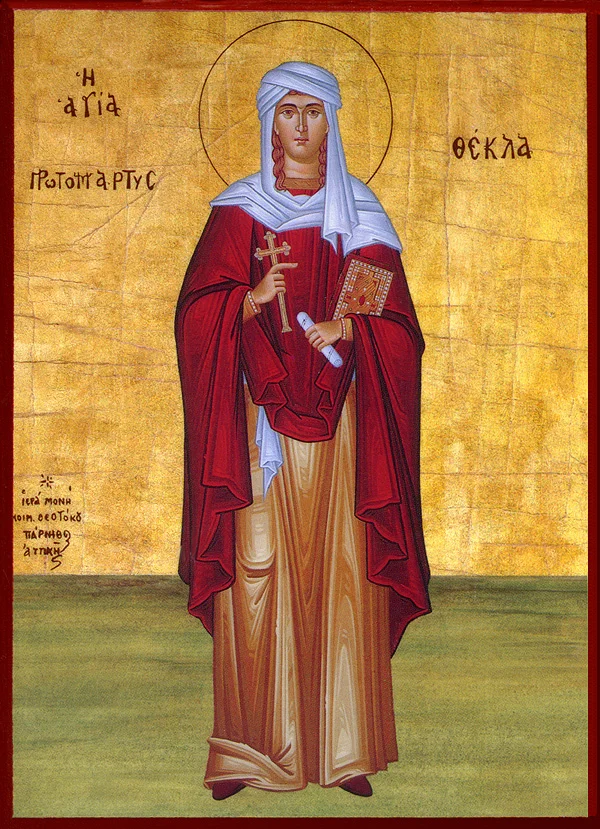
Thecla was honored in both eastern and western Christian communities. Her image appeared in art, and writers praised her as a virgin, martyr, and model of faith, even though the Acts does not end with a conventional martyrdom. Her cult gave generations of women a revered figure whose story centered on choosing a religious path beyond family control and social expectation.
Legacy
Thecla’s influence rests on the power of her story and on the communities that preserved and celebrated it. Medieval and modern readers have interpreted her in different ways: as an example of ascetic devotion, a missionary, a healing saint, or a figure who challenges conventional gender roles.
Her biography is inseparable from the literary tradition that made her famous. The Acts of Paul and Thecla cannot confirm the details of her life, but it reveals what early Christians imagined about courage, authority, and the possibilities of women’s religious work. The enduring cult of Thecla shows how strongly that imaginative figure resonated across centuries.