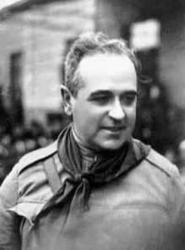
Theodor Oberlander
 Germany
Biography of Theodor Oberlander
Theodor Oberlander was a German politician and academic. He was born into a Protestant family and completed his education in agricultural studies at the Ludwig Maximilian University of Munich. He earned his doctorate in agricultural sciences in Berlin and later in political science in Königsberg. Oberlander worked as an agronomist and conducted research in Eastern Europe, including visits to the Soviet Union, China, Japan, Canada, and the United States.
In 1933, Oberlander became the head of the Institute of East European Economics at the University of Königsberg. He later served as an adjunct professor of agriculture and director of the Institute of Eastern Europe in Danzig. He also held the position of Reichsleiter of the Union of Germans of the East. In 1937, he began working at the University of Greifswald, and in 1938, he became a member of the Abwehr, the German military intelligence agency.
During World War II, Oberlander was involved in the planning and execution of Nazi policies in occupied territories. He advocated for the establishment of a "new order" in Eastern Europe, which included the destruction of populations to ensure German dominance. He held various leadership positions within the Nazi party, including as a political leader of the Nachtigall Battalion and commander of the Bergmann Battalion.
After the war, Oberlander was captured and held as a prisoner by the Allied forces. Following his release, he worked as an agricultural worker and later as a seed production manager in Bavaria. In 1948, he joined the Free Democratic Party of Bavaria and became a founding member of the Union of Expellees and Disenfranchised Persons (SIOD). He served as the leader of the SIOD's Bavarian division and held positions within the party's leadership.
In 1953, Oberlander was appointed as the State Secretary for Refugee Affairs in the Bavarian Ministry of Internal Affairs. He later served as the Minister for Refugee Affairs, Resettlement, and War Victims. In 1957, he was elected as a member of the Bundestag, representing the Christian Democratic Union. However, he faced increasing public pressure due to allegations of his involvement in war crimes.
In 1960, Oberlander was convicted in absentia by an East German court for his role in the execution of thousands of Jews and Poles in Lviv. He submitted his resignation, which was initially rejected, but he ultimately resigned from his post. Despite the controversy, he was re-elected as a member of the Bundestag in 1963 and served until 1965.
Oberlander remained active in various organizations and signed the Heidelberg Manifesto in 1981, which called for restrictions on immigration in Germany. He was awarded the Bavarian Order of Merit in 1986. In 1993, his previous conviction was overturned by a Berlin court. In 1996, he faced new criminal charges for the murder of a civilian in Kislovodsk in 1942. Oberlander denied the allegations. He is the father of history professor Erwin Oberlander and the grandfather of professor Christian Oberlander.