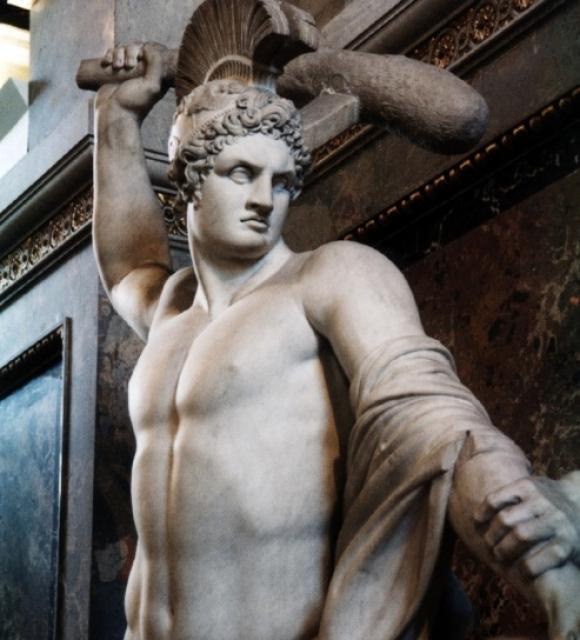
Theseus
- Birth and Origins of Theseus
- Founder and Statesman
- The Prophesied Hero
- Hero's Journey
- The Six Labors of Theseus
- Conquering the Minotaur
- Treachery and Loss
- Later Exploits and Legacy
Birth and Origins of Theseus
Theseus: A Mythical HeroIn Greek mythology, Theseus stands as a colossal figure. His name evokes the formidable conqueror of the monstrous Minotaur. However, beyond this renowned feat lay a multifaceted persona that challenged the classical archetype of a warrior hero.
Founder and Statesman
Theseus emerged not merely as a valiant fighter but as an astute statesman and founding father of Athens. Credited with numerous political achievements, his governance skills commanded respect. As a son of Aegeus, King of Athens, and the sea god Poseidon, Theseus bore an intriguing lineage further enriched by a pivotal prophecy at birth.
The Prophesied Hero
Before his arrival, omens hinted at Theseus' extraordinary destiny. His mother, Aethra, found herself blessed with not one but two fathers: Aegeus and the powerful Poseidon. Upon his departure, Aegeus buried a sword and sandals beneath a hefty rock, promising a royal inheritance to the worthy soul who could uncover them.
Hero's Journey
As a young man, Theseus embarked on a perilous quest to claim his father's throne. Faced with two paths, he boldly chose the more challenging land route, which presented six formidable opponents guarding the gates of the Underworld.
The Six Labors of Theseus
1. Periphetes:A brigand wielding a bronze club, Periphetes met his end when Theseus cunningly lured him into relinquishing his weapon, which became the hero's signature attribute.
2. Sinis:A notorious robber, Sinis condemned his victims to a gruesome fate. Yet, Theseus vanquished him, employing Sinis' own method of execution.
3. Crommyonian Sow:A monstrous beast, the Crommyonian Sow's reign of terror was halted by Theseus, who demonstrated his unwavering bravery.
4. Sciron:A cunning highwayman, Sciron forced travelers to wash his feet, only to hurl them into the sea and feed them to a giant turtle. Theseus outwitted and killed him, sharing his adversary's gruesome demise.
5. Cercyon:A ruthless wrestler, Cercyon challenged passersby to a battle, offering his kingdom to the victor. However, Theseus' prowess overpowered him, claiming his life and his prize.
6. Procrustes:A torturous villain, Procrustes offered travelers a bed of dubious comfort. Those who fit were stretched until they met an untimely demise, while the tall were brutally shortened. His own fate mirrored his cruelty as Theseus adjusted the bed to his unyielding dimensions.
Conquering the Minotaur
Upon reaching Athens, Theseus' claims to the throne were met with resistance from his stepmother, Medea. Determined to prove his worth, he volunteered to face the Minotaur, a monstrous dweller of Crete's labyrinth. With the aid of Ariadne, the Cretan princess, Theseus navigated the maze, vanquished the beast, and emerged victorious.
Treachery and Loss
In a bitter twist of fate, Theseus' triumph was marred by his betrayal of Ariadne. He abandoned her on the island of Naxos after promising to wed her. His return to Athens was further marked by a tragic mistake: forgetting his agreement with Aegeus, he neglected to replace his ship's black sails with white ones. Seeing the somber sails, his father plunged to his death, believing Theseus had perished.
Later Exploits and Legacy
Despite the trials and tribulations that plagued his life, Theseus continued his extraordinary adventures. He journeyed to the underworld, faced supernatural beings, and even briefly ruled Athens. His legacy extended beyond his immediate reign, leaving an indelible mark on Greek mythology and culture. As a foundational figure and an embodiment of courage and cunning, Theseus stands as a testament to the enduring power of human heroism and the complexities that often accompany it.


