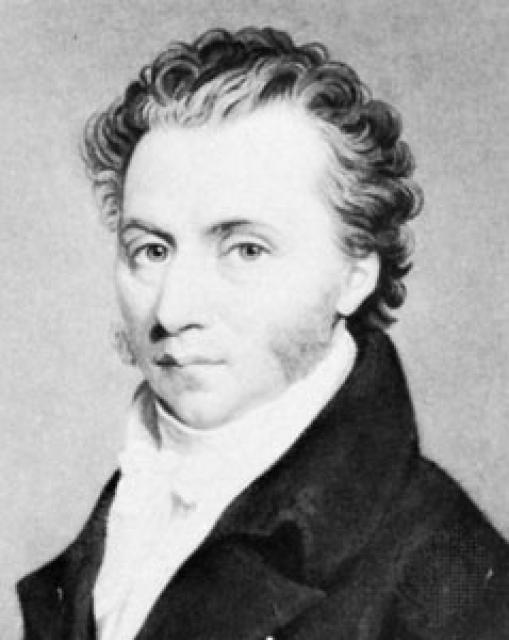
Thomas Attwood
 Great Britain
- Biography of Thomas Attwood
- Involvement in Political Campaigns
- Economic Theories and Political Reforms
- Political Union and Parliamentary Reforms
- Continued Activism and Retirement
Biography of Thomas Attwood
Early Life and CareerThomas Attwood, son of Matthias and Ann Attwood, was born on October 6, 1783, in Halesowen, Shropshire, England. His father was a successful businessman involved in coal and iron trade, as well as owning a bank in Birmingham. After receiving education at Wolverhampton Grammar School, Thomas began working in his father's bank.
Involvement in Political Campaigns
Attwood's first foray into politics came when he became involved in the campaign against the East India Company. He believed that the company's actions were strictly limited to external trade. Like many local businesses dependent on exports, the East India Company was blamed for the growing unemployment in Birmingham.
In 1812, the government appointed a special committee in the House of Commons to investigate the activities of the East India Company. Attwood led the delegation from Birmingham, providing testimony to the committee. His compelling testimony played a significant role in the House of Commons decision to restrict the company's monopoly in foreign trade.
Economic Theories and Political Reforms
Attwood developed a keen interest in economic issues and in 1815, he proposed his own course of action to reduce unemployment. He advocated for a paper currency not tied to gold and argued that the government should combat economic depression by increasing the money supply. Although his economic theory gained popularity in Birmingham, he failed to convince the government. Despite this, Attwood's leadership resulted in over 40,000 people signing a petition in support of monetary reform.
Attwood also believed that more people with business experience and knowledge of economics were needed in Parliament. This belief led to increased demand for representation from large cities like Birmingham in Parliament.
Political Union and Parliamentary Reforms
On January 25, 1830, approximately 10,000 people attended the first meeting of the Birmingham Political Union. Attwood and other leaders of the organization delivered speeches that captivated the audience for six hours. This meeting was followed by another in May, where over 80,000 people participated. Other industrial towns in Britain followed Birmingham's example and formed their own political unions.
Over the next two years, Attwood played a prominent role in the fight for parliamentary reforms. When the Reform Bill was ultimately passed in 1832, Attwood was named an Honorary Freeman of the City of London. In the subsequent general elections, he and Joshua Scholefield, another leading member of the political union, were elected as Birmingham's first members of Parliament without opposition.
Continued Activism and Retirement
Attwood persistently worked to convince his fellow Members of Parliament of the soundness of his economic ideas. However, he faced failure in persuading them and concluded that further parliamentary reform was necessary. In May 1837, the Birmingham Political Union was revived, and in June, a new set of demands was formulated, including monetary reform, a three-year parliament, payment for MPs, and the abolition of property qualifications.
In January 1838, Attwood and the Birmingham Political Union began collaborating with the London Working Men's Association in the fight for suffrage. However, he faced opposition from influential Chartist leader Feargus O'Connor, who was closer to William Lovett, Henry Hetherington, John Cleave, and other advocates of "moral force."
In June 1839, Attwood presented the first national petition to the House of Commons, which, despite collecting over 128,000 signatures, was rejected with 235 votes against and only 46 in favor. Faced with the parliament's reluctance to respond to public pressure and realizing that many Chartist leaders doubted monetary reform, Attwood decided to retire from parliament. From then on, he tried to stay away from any political involvement.
Later in his life, Thomas Attwood suffered from progressive paralysis. He passed away in Great Malvern, Worcestershire.


