Thomas Coryat
 Great Britain
- Early life and courtly beginnings
- The European journey and Coryat’s Crudities
- Eastward to India
- Death and legacy
Thomas Coryat was an English traveler whose curiosity carried him from the villages and roads of Europe to the court of the Mughal emperor in India. He turned his journeys into vivid, often comic writing, and his 1611 book Coryat’s Crudities remains one of the most distinctive early English travel accounts.
Early life and courtly beginnings
Coryat was born around 1577 in Odcombe, Somerset, the son of the local rector, George Coryate. He studied at Winchester College and Gloucester Hall, Oxford, though he left the university without taking a degree. His classical education and gift for performance later shaped the lively, digressive voice of his travel writing.
By the early 1600s, Coryat was associated with the royal court and served in the household of Prince Henry, the eldest son of James I. Known for his wit and eccentric manner, he gained a reputation as a comic figure at court. Yet the humor was only one part of his character: he was also observant, persistent, and eager to learn about the places beyond England.
The European journey and Coryat’s Crudities
In 1608, Coryat set out on a five-month journey through France, Savoy, Italy, Switzerland, parts of Germany, and the Netherlands. Much of the trip was made on foot. He paid close attention to architecture, customs, food, religious practices, and the everyday life of the people he encountered, recording details that more formal diplomatic accounts often passed over.
He published the journey in 1611 as Coryat’s Crudities: Hastily Gobled Up in Five Moneth’s Travells. The long, playful title reflected the book’s exuberant style. Its pages mixed practical observations with digressions, jokes, and descriptions of mishaps. The volume also carried comic verses by prominent writers of the period, including Ben Jonson and John Donne, who teased Coryat even as they recognized his unusual ambition.
The book is frequently described as an early travel guide or one of the first major English travelogues. It also preserved small cultural observations with lasting effects. Coryat described Italians using forks at meals, a custom then unfamiliar to many English readers, and his account of a sunshade used in Italy is often cited as the first written English reference to the word “umbrella.” He did not invent either the object or the practice, but he helped introduce them to English readers.
Eastward to India
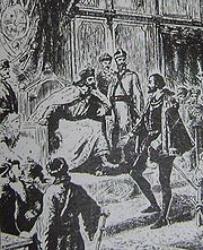
The European tour did not satisfy Coryat’s appetite for travel. He later journeyed east, passing through the Ottoman and Persian worlds before reaching the Mughal Empire. In 1616, he sent letters from Agra describing the court and the life he encountered there. He reportedly learned languages including Persian and Hindustani, and was presented to the Mughal emperor Jahangir, to whom he delivered an address in Persian.
Coryat’s accounts from India appeared in print during his lifetime and after his death, including Thomas Coriate Traveller for the English Wits. His writing is valuable not only for its colorful personality but also for the details it preserves about early seventeenth-century travel and cross-cultural encounters.
Death and legacy
Coryat died in Surat in December 1617, probably of dysentery, before he could return to England. He was about forty. His grave was later difficult to identify, but his books survived as lively records of an age when long-distance travel was dangerous, slow, and still a remarkable undertaking.
His self-mocking persona earned him the nickname “the Odcombian leg-stretcher,” but Coryat was more than a court eccentric. He was a keen observer who embraced travel as a way to learn and write. His accounts helped make the traveler’s own voice central to English travel literature, preserving both the spectacle of distant places and the small details of daily life.