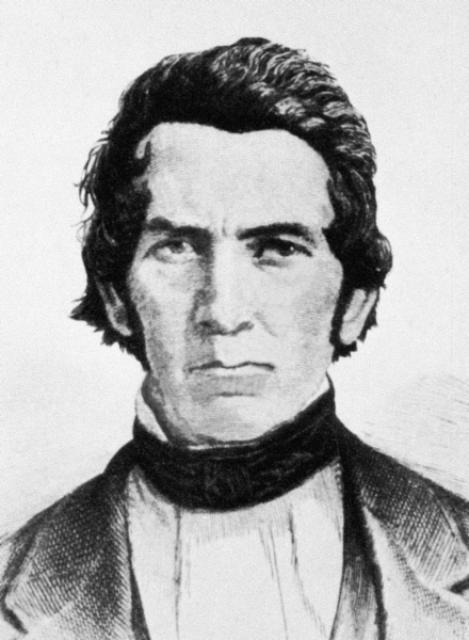
Thomas Davenport
 USA
USABiography of Thomas Davenport
Thomas Davenport was an American blacksmith and inventor who was born on July 9, 1802, on a farm near Williamstown, Vermont. He was the eighth child out of twelve in his family. At the age of 14, Thomas was apprenticed to a blacksmith, where he worked for seven years.
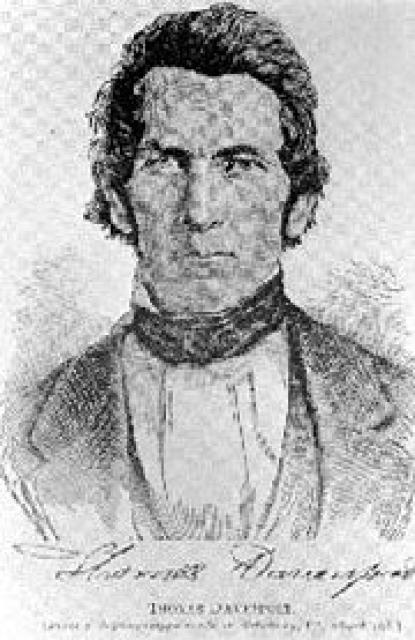
In 1823, Davenport moved to a village near Brandon, Vermont, where he established his own workshop. He married Emily, the daughter of a local merchant. Thomas was mostly self-taught, acquiring knowledge by reading books and magazines to stay up to date with the latest engineering advancements.
In the spring of 1833, Davenport became interested in the use of electromagnets for separating iron ore, a technology developed by Joseph Henry. He traveled 40 km to Crown Point, where he observed the remarkable properties of magnets. With the help of his brother, Thomas acquired his own electromagnet. He conducted experiments using these magnets, powered by a Voltaic battery, with the assistance of his wife.
During one experiment, Thomas attached a magnet to a wheel and another to a stationary frame. When the magnets interacted, the wheel completed half a rotation. Davenport invented a mechanism, similar to a brush and commutator, to switch the polarity of the magnet attached to the wheel, enabling continuous rotation. With this, he created an electromotor and built a model electric train that ran on a circular track with a diameter of 1.2 meters, powered by a stationary battery.
Inspired by his success, Thomas went to Washington, D.C. to obtain a patent. However, he was denied as there were no existing practices for patenting electric machines at that time. Undeterred, Davenport started touring colleges, demonstrating his invention to professors and collecting letters of support. The newly established Rensselaer Polytechnic Institute decided to purchase his model. With the proceeds, Thomas, along with his assistant Orange Smalley, built a second electromotor. He traveled to Princeton to meet Joseph Henry and the University of Pennsylvania to meet Benjamin Franklin Bache. Gathering favorable reviews, Davenport returned to the patent office.
Although a fire destroyed the prepared demonstration model, Davenport persevered, constructing a new working model. Finally, on February 25, 1837, he received his patent. Davenport's invention gained recognition, and the press hailed it as a scientific revolution. He opened a workshop on Wall Street and sought investors. He met Samuel Morse and founded the newspaper "The Electro-Magnet and Mechanics Intelligencer," using an electric motor-powered printing press. However, Davenport's enterprise suffered commercial failure, and he returned to Vermont, where he began writing a book. In 1851, Thomas Davenport passed away in Salisbury, Vermont.
In 1929, Thomas Davenport's nephew, Walter Rice Davenport, published a book about his uncle titled "The Brandon Blacksmith, Inventor of the Electric Motor." The book was based largely on Thomas' autobiography, which he had written in 1849.