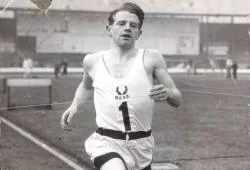
Thomas Pelham Curtis
 USA
Thomas Pelham Curtis’s athletic career reached its summit in Athens in 1896, at the first Olympic Games of the modern era. A student athlete from Boston’s sporting circle, he won the 110-metre hurdles in a close finish and later helped preserve the event’s history through his writing and photographs. His life after sport ranged from electrical engineering to service in the Massachusetts National Guard.
From California to MIT
Curtis was born in San Francisco on 9 January 1873 and grew up in a prominent Boston family. He studied electrical engineering at the Massachusetts Institute of Technology, where he competed in track and played varsity football. Though closely associated with the class of 1894, he did not complete the formal requirements for a degree. He later continued his studies at the Polytechnikum in Dresden, Germany.
By the mid-1890s, Curtis was running with the Boston Athletic Association. The American team for Athens came together quickly, with little of the long preparation that modern Olympic competitors expect. In an account he published years later, Curtis recalled the athletes practicing aboard their ship and even taking the opportunity to train during a brief stop in Gibraltar.
A Victory in Athens
At the 1896 Games, Curtis entered both the 100 metres and the 110-metre hurdles. He won his heat in the 100 metres but did not take part in the final. The hurdles were the race he had traveled to run. In the final, he faced Britain’s Grantley Goulding, widely regarded as the stronger hurdler. Goulding led for much of the contest, but Curtis’s speed carried him past in the closing stretch. He crossed first by roughly a yard, securing the title in a time of 17.6 seconds.
The first modern Olympics did not yet award gold medals to champions. Curtis received the era’s first-place prize: a silver medal, an olive branch, and a diploma from the Greek organizers. His victory placed him in the record books as the winner of the inaugural Olympic 110-metre hurdles title.
Curtis also documented the atmosphere around the competition. His parents had given him a camera, and many of the surviving photographs of the Athens Games are attributed to him. In a 1924 account, he described arriving at the stadium to face a vast crowd and the Greek royal family. His recollections became one of the early American eyewitness records of the revived Olympics.
Engineering, Military Service, and Family
After his studies, Curtis returned to the Boston area and entered business with fellow MIT alumnus F. W. Lord. Their Lord Electric Company worked as an electrical contracting firm. He remained active in sports and community organizations, including the Boston Athletic Association, tennis and racquet clubs, and the Massachusetts National Guard.
Curtis rose to captain in the Guard and served as a military aide to Massachusetts Governor Calvin Coolidge during the First World War. He married Frances K. Small in 1893, and they had four children. He died in Nahant, Massachusetts, on 23 May 1944, aged 71.
Curtis’s Olympic victory came in a brief, tightly contested race, but its place in history endured. He was not only the first champion of the Olympic hurdles; through his camera and his written recollections, he also became an important chronicler of the Games that launched the modern Olympic tradition.