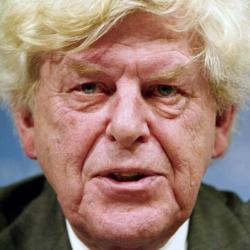
Thomas Robert Malthus
 Great Britain
- Biography of Thomas Robert Malthus
- Physical Appearance and Personal Life
- Academic Career
- Solutions to the Problem
- Legacy
Biography of Thomas Robert Malthus
Thomas Robert Malthus was an English economist, scientist, and prominent expert in political economy and demography. He was the founder of a fundamentally new school of economic thought. Malthus was born as the sixth child of Daniel and Henrietta Malthus. He spent his childhood in a rural house near Westcott, Surrey. Malthus initially studied at home and later attended Warrington Academy. In 1784, he enrolled at Jesus College, Cambridge. At the college, Malthus excelled in Latin, Greek, English declamation, and mathematics. In 1791, he obtained a master's degree and six years later, he was ordained as a clergyman and moved to the village of Okewood, near Albury, Surrey.
Physical Appearance and Personal Life
Contemporaries described Malthus as a highly likeable person, except for his hare lip and wolfish mouth. This physical defect also affected his voice. It is known that Malthus was very self-conscious about his physical flaws and even refused to pose for a portrait until 1833. On April 12, 1804, Malthus married his cousin Harriet, and they had three children: Henry, Emily, and Lucy.
Academic Career
In 1805, Malthus obtained a position as a professor of history and political economy at East India Company College in Hertfordshire. He gained incredible authority and respect among the college students. From 1798 to 1826, Malthus published six editions of his most famous work, "An Essay on the Principle of Population." In each new edition, Malthus included additional data he obtained from further research and criticisms. Malthus initially wrote this work as a response to his father's overly optimistic views on the prospects of societal development and improvement. Malthus himself viewed the prospects of society with skepticism. In his work, he argued that throughout history, there has always been a layer of society doomed to poverty. Malthus attributed this undesirable permanence to the excessive growth of the planet's population. He believed that population growth would continue until serious problems arise due to the scarcity of basic resources.
Solutions to the Problem
Malthus saw two solutions to the problem he identified: measures to increase mortality and measures to reduce fertility. Mortality rates increased during wars and epidemics, while reducing fertility could be achieved through the legalization of abortions and prostitution, as well as controlling reproduction and popularizing late marriages. Malthus had deep doubts about "positive" measures that were considered to help increase the number of people who could coexist in the world.
Legacy
Thomas Malthus passed away on December 23, 1834, and his body was buried in Bath Abbey. It is worth noting that Malthus lived most of his life, as befitting a clergyman, in modesty. He had several opportunities to hold prestigious positions in the government or advance in the church hierarchy, but Malthus ignored all these possibilities, choosing to concentrate on his scientific work.