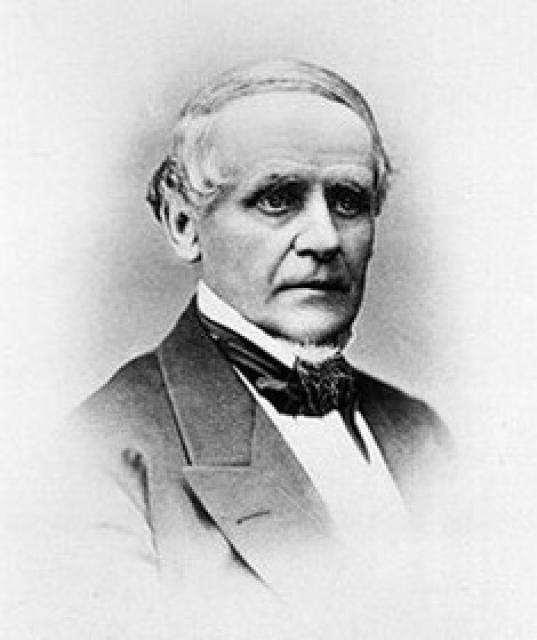
Thomas Story Kirkbride
 USA
USA- Thomas Story Kirkbride: American Pioneer in Mental Health
- Career in Psychiatry
- Kirkbride's Architectural Legacy
- Publication and Mixed Reception
- Personal Life and Legacy
- Preservation of Kirkbride Architecture
Thomas Story Kirkbride: American Pioneer in Mental Health
Early Life and Medical EducationThomas Story Kirkbride was born in 1809 into a Quaker family in Morrisville, Pennsylvania. Guided by his passion for medicine, he commenced his medical studies under Dr. David Herman Langhbibel in 1828 at the age of eighteen. Kirkbride earned his medical degree from the University of Pennsylvania in 1832, establishing his own practice from 1835 to 1840.
Career in Psychiatry
In 1840, Kirkbride was appointed as the superintendent of the Pennsylvania Hospital for the Insane. Driven by his dedication to improving mental healthcare, he contributed to the establishment of the Association of Medical Superintendents of American Institutions for the Insane (AMSAII) in 1844. Kirkbride served as its president from 1862 to 1870.
Kirkbride's Architectural Legacy
Kirkbride is renowned for his architectural designs that shaped the construction of large-scale mental hospitals in the United States during the late 19th century. His "Kirkbride Plan" emphasized the importance of providing ample space, natural light, and ventilation for patients. This plan was incorporated into several hospitals, including the St. Elizabeths Hospital in Washington, D.C.
Publication and Mixed Reception
Kirkbride's influential work, "On the Construction, Organization, and General Arrangements of Hospitals for the Insane; with Some Remarks on Insanity and Its Treatment," was published in 1854 and again in 1880. His ideas elicited mixed reactions within the medical community. While some criticized his idealistic perspectives, others recognized their transformative potential in the treatment of mental illness. Among patients, Kirkbride's approach occasionally evoked fear and resentment, even leading to an assassination attempt. Nevertheless, he remained committed to the belief that mental illness could be treatable and potentially curable.
Personal Life and Legacy
Kirkbride married Ann West Jenks in 1839 and had two children. Following the loss of his first wife, he married a former patient. Kirkbride passed away from pneumonia in 1883 at his residence within the Pennsylvania Hospital for the Insane. His contributions to the field of mental health continue to shape contemporary perspectives on the treatment and care of individuals with mental illness.
Preservation of Kirkbride Architecture
Many Kirkbride-designed hospitals have faced abandonment and demolition over time. However, several notable examples have been preserved and repurposed. The former Travers City Hospital, now known as "The Village," is a testament to Kirkbride's architectural legacy, having been saved from deterioration and restored to serve the community once again.