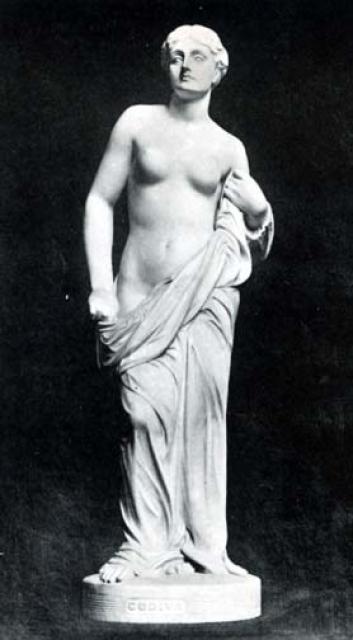
Thomas Woolner
 Great Britain
Biography of Thomas Woolner
Thomas Woolner was an English sculptor and poet, known for his association with the Pre-Raphaelite Brotherhood and his close friendship with Alfred Lord Tennyson. He was born in Suffolk, England, and began exhibiting his works at the Royal Academy of Arts in 1843. In 1875, he was elected as a member of the Royal Academy.

Artistic Style and Works
Woolner did not share the Pre-Raphaelites' love for the Middle Ages, but he fully embraced the principle of "truth to nature" advocated by John Ruskin. From the beginning of his career, Woolner paid special attention to artistic details. He gained fame for his busts and engravings.
One period of his life saw him forced to emigrate to Australia, but he later returned to Britain where he established himself as a sculptor and art dealer. His most famous sculptures include "Civilisation" and "Virgilia." In these works, Woolner attempted to capture the intense state of human emotions and the dynamics of human passions. "Virgilia" refers to the wife of the main character in William Shakespeare's tragedy "Coriolanus." Shakespeare drew the plot from Plutarch's manuscript, which tells the story of the Roman general Coriolanus in the 5th century and his struggle against rebels.
Poetry
Woolner was also a poet who gained some recognition in his time. His early poem, "My Beautiful Lady," was published in the magazine "Rostock" in 1850 and is a typical product of the Pre-Raphaelite movement. However, he later moved away from the Pre-Raphaelite style and embraced classical forms in his poetry. Some of his later poems include "Pygmalion," "Silenus," and others.
Contributions to Science
While working on the statue of Paca, Woolner conducted a comparative study of the shape of the human earlobe and those of animals. As a result, he described for the first time the structure that would later be named the "Darwin's tubercle."
Overall, Thomas Woolner made significant contributions to both the fields of sculpture and poetry, leaving behind a legacy of artistic and scientific accomplishments.





