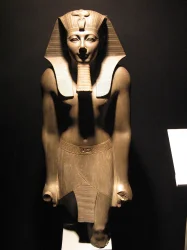
Thutmose III
- A Young King
- Megiddo and the Northern Campaigns
- The Annals and the Egyptian State
- Building and Patronage
- Legacy
Thutmose III ruled Egypt during the height of the Eighteenth Dynasty, a period when the kingdom extended its influence across much of the eastern Mediterranean and into Nubia. He is remembered as a forceful military ruler, especially for the campaign at Megiddo, but his reign also depended on diplomacy, administration, and an ambitious program of temple building. The records carved at Karnak preserve a rare, detailed account of his campaigns and the wealth they brought to Egypt.
A Young King
Thutmose III became pharaoh as a child after the death of his father, Thutmose II. His stepmother and aunt Hatshepsut acted as regent and later ruled as pharaoh alongside him. The chronology of their shared rule and the young king’s exact role remain debated, but Hatshepsut was the senior ruler for much of the first part of his reign. Thutmose’s reign was later counted as beginning around 1479 BCE, which gives him a total rule of roughly fifty-four years when the co-regency is included.
After Hatshepsut’s death, Thutmose governed alone. In the years that followed, his government worked to strengthen Egyptian authority in territories where local rulers and rival powers could challenge it. Rather than simply set out on conquest, he repeatedly returned to the Levant to secure tribute, suppress revolts, and preserve Egypt’s strategic position.
Megiddo and the Northern Campaigns
Thutmose’s first major campaign as sole ruler targeted a coalition of rulers centered on Megiddo, a fortified city in Canaan. The Egyptian army faced a choice of routes through the surrounding hills. Thutmose’s annals say he selected a narrow pass that brought his forces closer to the city, an approach his commanders had considered risky. The Egyptians won the battle, and the coalition retreated behind Megiddo’s walls. The city was captured after a siege.
The campaign at Megiddo became the best-known event of his reign. The victory did not end Egypt’s work in the region: Thutmose led further campaigns into Syria and the northern Levant, including expeditions toward the Euphrates and against the Mitanni. He also conducted campaigns in Nubia to reinforce Egyptian authority to the south. The royal records list seventeen campaigns, although their purpose and outcomes varied. Some were major military operations; others secured the submission of rulers and the delivery of tribute.
The Annals and the Egyptian State
Thutmose ordered his military achievements recorded on the walls of the temple of Amun at Karnak. These annals describe campaigns, captured goods, tribute, and diplomatic exchanges. They are among the most important sources for the political and military history of New Kingdom Egypt. They also present the pharaoh in the traditional role of a divinely favored ruler whose victories upheld cosmic order. Like other royal inscriptions, they are official accounts, not neutral reports, and must be read with that purpose in mind.
The empire’s stability depended on more than its army. Egyptian officials governed conquered territories through local leaders, garrisons, and the collection of tribute. Foreign princes were sometimes brought to Egypt for education at court, which strengthened ties and ensured that rulers abroad understood Egyptian expectations. The resulting networks connected Egypt to a wide region of trade and diplomacy.
Building and Patronage
Thutmose’s reign was marked by extensive building. At Karnak, he added a festival hall known as the Akh-menu and expanded the great temple complex of Amun. Its walls carried inscriptions and reliefs commemorating royal ceremonies, campaigns, and offerings. He also sponsored construction and restoration at sites throughout Egypt and Nubia, using temple projects to reinforce both religious devotion and royal authority.
He died around 1425 BCE and was buried in the Valley of the Kings. His son Amenhotep II succeeded him. Thutmose’s mummy was later recovered from a royal cache, and his monuments remain among the most important archaeological records of the Eighteenth Dynasty.
Legacy
Thutmose III’s modern reputation as Egypt’s greatest military pharaoh reflects the scale of his campaigns and the unusually rich records that survive. Yet his achievement was not simply the expansion of borders. He maintained Egyptian influence through repeated expeditions, regional administration, diplomacy, and public building. His reign shows how Egypt’s power depended on turning battlefield success into a durable system of tribute and political relationships.