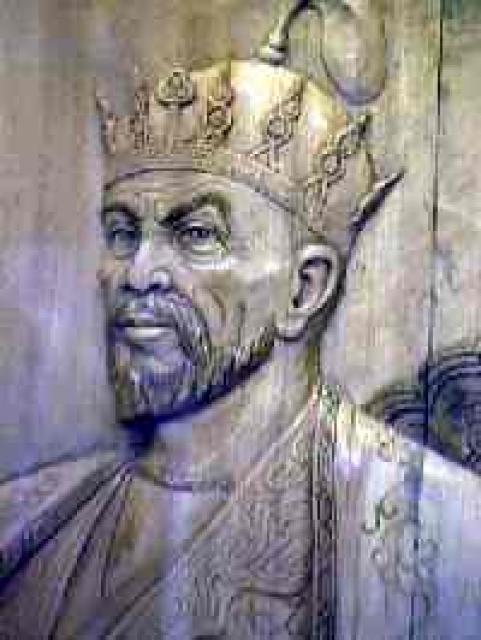
Timur Tamerlan
 Mongolia
Biography of Timur Tamerlan
Timur Tamerlan was a Central Asian statesman, military commander, and emir since 1370. During his lifetime, Timur's character and actions were surrounded by so many contradictions that it is impossible to untangle them. He did not enter history under any of his names: Timur, Tamerlane, or Guragan.
On August 26, 1395, Moscow welcomed the Vladimir Icon of the Mother of God. Metropolitan Kiprian, along with a multitude of people, prayed for the protection of Moscow from the Timur's hordes. However, Timur did not attack Moscow but instead turned towards Yel'tsa and burned it. He then plundered the trading cities of Azov and Kafa in Crimea, followed by the destruction of Saray and Astrakhan. News of his campaigns quickly spread to Europe, and they too began to tremble at the name of the "Great Lame One." Seven years later, in 1402, Europe was once again gripped by fear, anticipating an invasion from Central Asian hordes. Timur defeated and captured the Ottoman Sultan Bayezid I, known as Bayezid the Thunderbolt, during the Battle of Ankara. Bayezid was considered invincible and had conquered Anatolia and much of the Balkans. This victory ended the Crusades against the Muslims, as Bayezid had previously defeated the Crusader army under King Sigismund of Hungary at the Battle of Nicopolis in 1396. The defeat of Bayezid was a significant blow to European ambitions in the East.
Timur's conquests and victories were widely celebrated and acknowledged by European kings. The Genoese raised Timur's banner over the towers of Pera in the Golden Horn. The Emperor of Constantinople and the Sultan of Egypt hurried to recognize Timur's authority and offered to pay tribute. King Henry IV of England and King Charles VI of France congratulated Timur on his great victory. King Henry III of Castile sent his envoys, led by the valiant knight Ruy González de Clavijo, to Timur. Europe prepared for the worst, expecting an invasion from Timur. However, once again, Timur surprised everyone by turning his war horses back towards Samarkand.
Many historians have described various aspects of Timur's life. They have dedicated so much attention to him that they collected any information about him, no matter how absurd. Therefore, many of the surviving testimonies are contradictory and often perplexing. Some medieval biographers and memoirists note Timur's extraordinary memory, his knowledge of Turkish and Persian languages, and how his knowledge of the histories of great conquerors and heroes helped him inspire his warriors before battle. However, these same sources claim that Timur was illiterate. How could a person who spoke multiple languages and had a phenomenal memory be illiterate? Why would he have personal readers if they could not teach him how to read? How could an illiterate person manage his vast empire, lead armies, determine the strength of his troops, and calculate his remaining reserves? How could an illiterate person astonish the greatest Muslim historian Ibn Khaldun with his knowledge of history? The interpretation of historians is also ambiguous when it comes to Timur's reputation as a merciless butcher who slaughtered his enemies and razed entire cities. If we believe this version, then Timur is not a great warrior and builder but a beast in human form.
There is no concrete evidence to support the atrocities attributed to Timur. Archaeologists have not found any confirmation. Not a single significant fragment of any tower constructed from "decapitated heads" has been found.
One must consider the distorted history surrounding Timur, how skillfully it can be done, and how truth, repeated many times by many, becomes accepted as truth. What is important is not who you are, but what others say about you. And thus, Timur, it seems, has fallen victim to this ancient story: from warrior and builder to butcher. Timur left many mysteries, and we will not find answers until we understand the reasons behind his endless military campaigns. Most historians speak too definitively about these reasons. For them, he is a typical despot dreaming of world domination. Such an approach does not explain anything. It is too complex a task to defeat one's enemies.
Today, we cannot comprehend the importance people in the Middle Ages placed on noble lineage. Our ancestors were too reverent towards their past. Timur could not become the full-fledged ruler of Maverannahr because he did not have the right to rule over this land. He could conquer everything except the right to rule over Maverannahr. He had to share power with the Khan of the Chagatai Khanate, the second son of Genghis Khan. According to the law established by Genghis Khan, only a Chinggisid could rule. Therefore, Timur was satisfied with the title of "Great Emir." The Khans during his reign were Suurgatmish (1370-1388) and Mahmud (1388-1402).
In the second half of the 14th century, the four ulus of the Mongol Empire, left by Genghis Khan, lost their unity. The Chagatai Khanate, in turn, split into Moghulistan (Semirechye and Eastern Turkestan) and Maverannahr (the land between the Amu Darya and Syr Darya). The khans of Moghulistan constantly fought with the rulers of Samarkand over disputed territories and ravaged Maverannahr. When the rootless Timur came to power in Samarkand, he united the scattered tribes under his rule and fiercely resisted the khans of Moghulistan, who saw him as a threat to their power. They believed that they could easily restore the prestige of their rule.
To unify his army and mobilize the peaceful population, Timur had to change the laws of his warriors. He turned to the experience of Genghis Khan, who, in 1206, during the Kurultai (assembly) on the banks of the Onon River, introduced military and administrative reforms after being elected Great Khan. Genghis Khan not only replaced the common tribal name "jubu" with the proud name "Mongol," but also introduced new decrees. From then on, the Yasas, or laws, determined the life of the Mongol Empire. To prevent a rebellion by the majority of the united army and to keep the number of Mongolian veterans in the new alliance less than a tenth, Genghis Khan abandoned the principle of lineage. From then on, all rewards and promotions were based on merit.
Timur returned to this time-tested legacy of his ancestors and quickly united the scattered tribes of the disintegrated Mongol Empire under his rule. The emirs and nobles of all the tribes in his horde were satisfied. For a man, there is only one path - war, and there is only one law - Yasas.
However, Timur understood that one law could not rule in his empire. He realized that warriors and common people needed different laws, but all of these laws had to instill fear and make people tremble at the thought of violating them.
Islam helped Timur prepare his subjects for the upcoming battles. The laws of Sharia united Maverannahr. Throughout Timur's reign, these laws protected the rear, united the people, and made them serve the emir faithfully. Sharia courts severed the heads of innocent people, forcing them to obey unified decrees. This enabled Timur to mobilize the limited resources of Maverannahr.
Timur revered the Yasas of Genghis Khan even more than the laws of Sharia. However, he could not oppose the army and the people. The emerging unity needed to be strengthened. For this, the Great Emir had to replace the native laws of his warriors with the laws of the Mongol Empire. It was an arduous task, but Timur succeeded.




