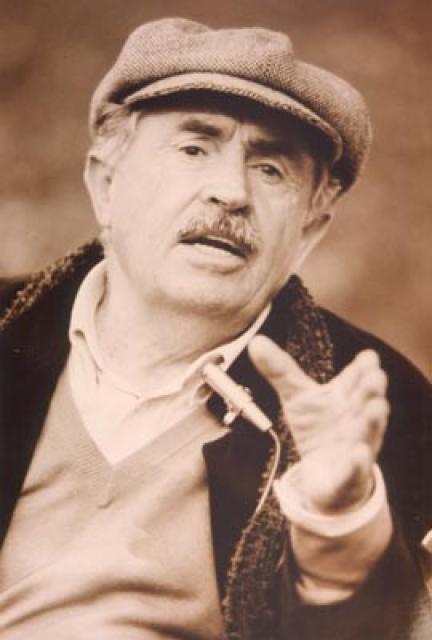
Tonino Guerra
 Italy
Italy- Biography of Tonino Guerra
- Screenwriting Career
- Collaboration with Russian Filmmakers
- Personal Life and Legacy
Biography of Tonino Guerra
Tonino Guerra was an Italian poet, writer, and screenwriter who collaborated with renowned directors such as Federico Fellini, Michelangelo Antonioni, Andrei Tarkovsky, Francesco Rosi, and Theo Angelopoulos. He was born on March 16, 1920, in the small village of San Arcangelo near Rimini and lived in the region throughout his life. He completed his education at the pedagogical faculty of the University of Urbino.
Screenwriting Career
Tonino Guerra began writing while in a Nazi concentration camp. Since 1953, he has written screenplays for films that have become classics of world cinema. He worked with directors such as Giuseppe De Santis, Mario Bolognini, Damiano Damiani, Mario Monicelli, and the Taviani brothers. For Michelangelo Antonioni, Guerra wrote "The Adventure," "The Night," "Eclipse," "Red Desert," "Blow-Up," "Zabriskie Point," "The Mystery of Oberwald," and "Identification of a Woman."
In collaboration with his close friend and fellow countryman Federico Fellini, Guerra conceived the play "Amarcord," which later became a famous film. They also worked on "And the Ship Sails On" and "Ginger and Fred." Guerra wrote the screenplay for Andrei Tarkovsky's documentary film "Voyage in Time" and the feature film "Nostalgia." Vladimir Naumov adapted Guerra's prose into films, including "White Holiday" and "Clocks Without Hands."
Collaboration with Russian Filmmakers
Guerra's first collaborative project with renowned Russian animator Andrei Khrzhanovsky was "The Lion with the Gray Beard," which achieved incredible success among Western audiences and critics, receiving numerous festival awards. They later collaborated on films based on Federico Fellini's drawings, such as "The Long Journey" and "Lullaby for a Cricket," dedicated to the 200th anniversary of Pushkin.
Personal Life and Legacy
In the mid-1970s, Tonino Guerra married Eleonora Yablochkina, a Soviet citizen. As a true admirer of the arts, he gifted her clay ancient figurines, Etruscan beads, and antique Venetian glass. He often expressed his affection through words, air, and fragrances. Guerra opened the restaurant La Sangiovesa in Rimini in honor of his friend Federico Fellini, decorating it with his own drawings. Throughout his life, he hung ceramic plaques with philosophical sayings, which he collected, on the walls of city houses.
Guerra's poems were translated into Russian by his close friend Bella Akhmadulina. He passed away on March 21, 2012, at the age of 92 in his native village of Santarcangelo di Romagna, where he was buried. His ashes were placed in the highest point of the garden, in a wall that remained from ancient times and once surrounded the castle of Duke Malatesta.
Tonino Guerra received numerous awards during his career, including the David di Donatello Award for Best Screenplay in 1981, 1984, and 1985, the Best Screenplay Prize at the Cannes Film Festival in 1984, the Order of Merit of the Italian Republic in 2002, the Sergei Parajanov Award at the Yerevan International Film Festival in 2006, and the Order of Honor in 2008. He was also an honorary foreign member of the Russian Academy of Arts.
Guerra received nominations for the Academy Awards (Oscars) for Best Original Screenplay in 1966, 1967, and 1976 for the films "Casanova '70," "Blow-Up," and "Amarcord," respectively.


