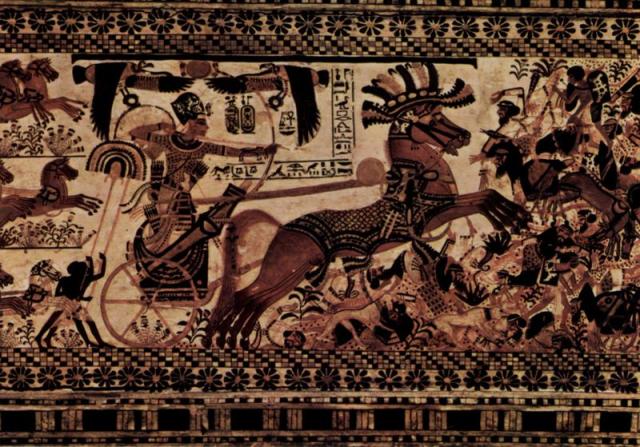
Tutanhamon
 Egypt
EgyptBiography of Tutankhamun
Pharaoh Tutankhamun was a pharaoh of the 18th dynasty of ancient Egypt, reigning from 1347 to 1337 BC. He was initially named Tutankhaton, meaning "Living Image of Aton," but later changed his name to Tutankhamun, meaning "Living Image of Amun." Tutankhamun's reign was initially considered insignificant, as his predecessors had reversed the reforms of Akhenaten. However, his discovery in 1922 made him one of the most famous pharaohs and a symbol of ancient Egyptian civilization.

Tutankhamun was the son of either Amenhotep III and his second wife Kiya, or Amenhotep IV (Akhenaten) and his wife Kiya. He married his half-sister, Ankhesenamun, who was the daughter of Akhenaten and Nefertiti. Tutankhamun ascended to the throne at the age of 8 or 9 and was initially influenced by the Atenist religion established by Akhenaten. However, his reign was largely controlled by his regents, Ay and Horemheb, who had turned against the Atenist ideology.

During Tutankhamun's reign, there was a religious and political shift back to traditional Egyptian culture. The capital city of Amarna was abandoned, and Memphis became the nominal capital, although Thebes (Luxor) was where Tutankhamun mainly resided. His regent Horemheb led successful military campaigns in Nubia and the neighboring regions in Asia, restoring Egypt's territories. Tutankhamun also commissioned the completion of various temples and built new ones, including the Karnak Temple and the Horon Temple.
Tutankhamun's tomb, known as KV62, was discovered in the Valley of the Kings by Howard Carter and Lord Carnarvon in 1922. It was the only almost intact royal tomb ever found and contained numerous treasures and artifacts. The discovery of Tutankhamun's tomb sparked a renewed interest in ancient Egypt and solidified his status as a significant historical figure.
Tutankhamun died at a young age, possibly around 18 or 19. The cause of his death was initially speculated to be murder orchestrated by his regent Ay, who became the next pharaoh. However, recent examinations of his mummy suggest that Tutankhamun likely died from gangrene resulting from a leg injury. The popular belief in the "Curse of the Pharaohs," which claimed that those who entered the tomb would suffer misfortune, was largely sensationalized by the media and not supported by factual evidence.
Despite his short and relatively uneventful reign, Tutankhamun's legacy endures through the remarkable discovery of his tomb and the treasures within it. His reign represents a period of transition and restoration in ancient Egypt's history, and his name continues to captivate the imaginations of people worldwide.