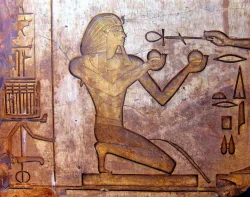
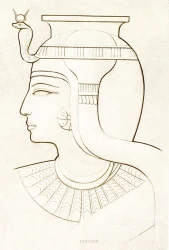
Twosret
Tausret, also known as Twosret or Tawosret, rose from the royal court to rule Egypt in her own name at the close of the Nineteenth Dynasty. First a queen, then regent for the young pharaoh Siptah, she eventually adopted the full authority of kingship. Her reign is still being pieced together from inscriptions, temples, and a tomb that a successor later altered.
Queen and Regent
Tausret’s birth and parentage remain uncertain. She became the great royal wife of Seti II, whose reign was marked by a contested succession. After his death, the young Siptah took the throne. Tausret served as a powerful court figure and regent during his rule, likely for several years. Her monuments use royal titles that show how her authority grew, although the precise balance of power between the queen and other officials at court remains debated.
A Pharaoh in Her Own Right
When Siptah died, Tausret assumed kingship in her own name, becoming one of the rare women in ancient Egypt to rule as pharaoh. Surviving evidence indicates she continued the regnal count begun under Siptah; inscriptions associated with her mortuary temple refer to Year 8, suggesting that she ruled independently for at least part of that period. The dates of her reign vary among modern chronologies, but she is generally placed around the late twelfth century BCE.
Tausret’s political position was not simply ceremonial. Royal iconography presented her with the traditional symbols and titles of a pharaoh, and she pursued building projects appropriate to the office. Her mortuary temple at Thebes was intended to secure her commemoration and royal cult, though only fragments survive. The remains are being studied by archaeologists to better understand the resources and political support available to her reign.
Tomb and Dynastic Change
Tausret’s tomb, KV14 in the Valley of the Kings, is among the largest royal tombs there. It began as a tomb connected with Seti II and was later expanded and decorated for Tausret. After her reign, Setnakhte founded the Twentieth Dynasty. The exact circumstances of the transition are unsettled: some evidence has been read as a violent overthrow, while it is also possible that Tausret died before a succession conflict. Setnakhte took over KV14, modifying its decoration and reusing it for his own burial.
Legacy
Tausret’s story survives in fragments, and later rulers’ interventions helped obscure her role. Modern excavations and reassessments of her inscriptions have restored a clearer picture of a monarch who moved through several levels of royal authority during a fragile succession. She remains the final ruler of the Nineteenth Dynasty and one of the New Kingdom’s most notable female pharaohs.