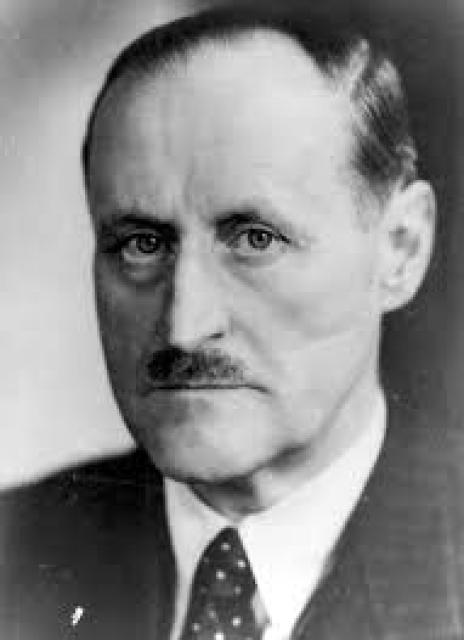
Ulrich Hassel
 Germany
Biography of Ulrich von Hassell
Ulrich von Hassell was a German diplomat and an active participant in the conspiracy against Adolf Hitler. He was born into the family of Lieutenant Ulrich von Hassell and his wife Margaret. He completed his education at the Prince Henry Gymnasium in 1899 and studied law and economics at the universities of Lausanne, Tübingen, and Berlin from 1899 to 1903. Historians Roger Manvell and Heinrich Fraenkel describe Hassell as "a patrician by birth and upbringing, an aristocrat and intellectual who chose a diplomatic career."
In 1911, he married Ilse von Tirpitz, the daughter of Admiral Alfred von Tirpitz. They had four children: Almut (1912), Wolf Ulrich (1913), Johann Dietrich (1916), and Fey (1918). Hassell served in the German colony of Qingdao in China and in London. From 1909, he worked at the central office of the Ministry of Foreign Affairs. From 1911 to 1914, he was the vice-consul in Genoa.
During World War I, Hassell joined the army as a reserve captain. On September 8, 1914, during the Battle of the Marne, he was severely wounded in the chest. After the war, he worked as an advisor and personal secretary to Admiral Tirpitz, and wrote his biography, which was published in 1920. In 1916, he temporarily left diplomatic service and was appointed as a government advisor in Stettin. From 1917, he served as the first director of the Federation of Prussian Districts in Berlin. He held conservative political views and became a founding member of the Fatherland Party established by Tirpitz in 1917. After the war, he joined the right-wing German National People's Party.
In 1919, Hassell returned to diplomatic service and was appointed as an embassy counselor in Rome. From 1921 to 1926, he served as the consul general in Barcelona, from 1926 to 1930 as an envoy in Copenhagen, from 1930 to 1932 as an envoy in Belgrade, and from 1932 to 1938 as an ambassador in Rome. Initially, he had a positive attitude towards Hitler's rise to power and joined the Nazi Party in 1933. However, he soon changed his stance and became a staunch opponent of the regime, particularly against the creation of the "Rome-Berlin Axis" and the signing of the Anti-Comintern Pact. He believed that Italy would be too weak of an ally for Germany.
As a result, in early 1938, he was recalled from Rome, although he officially remained in diplomatic service. This occurred within the framework of the "purge" of the army and the foreign ministry to eliminate officials who were not sufficiently loyal to the Nazis. At the beginning of World War II, Hassell led a delegation sent to the countries of Northern Europe to reassure their governments, which feared German invasion. By this time, he was already involved in the conservative opposition against Hitler, led by Carl Friedrich Goerdeler. Hassell participated in the planning of a coup d'état and was slated to become the Minister of Foreign Affairs in a post-Nazi government (another candidate was Count Werner von der Schulenburg, former ambassador to Moscow).
Hans-Bernd Gisevius, a participant in the conspiracy, described Hassell as someone with excellent humor, diplomatic resourcefulness, and unwavering political beliefs. Hassell was arrested in July 1944 following the failed assassination attempt on Hitler. While in prison, he told his fellow inmate, Fabian von Schlabrendorff: "My death is imminent. When you leave here, please give my regards to my wife. Tell her that in my final moments, I will be thinking of her." Hassell's younger daughter and son were also arrested.
On September 7-8, he appeared before the People's Court and displayed courage during the trial. He was sentenced to death by hanging and executed on September 8 at Plötzensee Prison. After World War II, Hassell's diaries, which he hid for some time in a tea box buried in the courtyard of his Bavarian home, were published and became an important testimony to the activities of various anti-Hitler groups.


