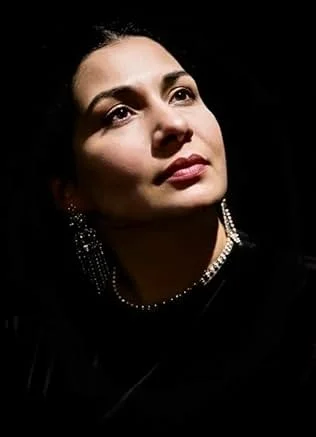
Umm Kulthum
- Childhood and First Performances
- The Move to Cairo
- Radio, Film and Stardom
- A National Voice
- Personal Life and Legacy
Umm Kulthum rose from a village in the Nile Delta to become one of the most celebrated voices in the Arab world. Her performances joined exacting control of classical Arabic poetry with the emotional force of live improvisation. For decades, her monthly radio concerts brought listeners across the region together, while her public identity became closely bound to modern Egypt.
Childhood and First Performances
Umm Kulthum was born into a modest family in Tamay al-Zahayra, a village in Egypt’s Nile Delta. Her father, Ibrahim al-Sayyid al-Baltagi, was an imam and religious singer who performed at local celebrations. As a child, she learned to recite religious texts and sang with her father’s troupe, sometimes dressed as a boy because public performance by girls was frowned upon.
Her exact birth year is disputed. Egyptian official sources commonly give 1898, while a later civil record gives 1904; the precise date cannot be established with confidence. What is clear is that her talent became apparent while she was still young. Her father brought her to sing in villages, where listeners were struck by her powerful voice and command of religious verse.
The Move to Cairo
By the early 1920s, established musicians encouraged the young singer to move to Cairo, the center of Egypt’s recording and performance industries. She arrived around 1923 and began studying the urban musical traditions that would shape her career. She worked with composers including Abu al-Ila Muhammad and Mohamed El Qasabgi, while poet Ahmed Rami became one of her most important creative collaborators.
Umm Kulthum did not simply preserve older music. She adapted classical Arabic poetry for a changing public and built a distinctive performance style: clear diction, carefully controlled phrasing and extended repetition that allowed a song to evolve in response to the audience. Her concerts could stretch a single composition into a long, emotionally charged exchange between singer and listeners.
Radio, Film and Stardom
In 1934, Umm Kulthum was among the first major performers to be heard on the newly established Egyptian radio service. Her regular concerts, often broadcast live on the first Thursday of each month, became a regional ritual. Cafés and homes across the Arab world tuned in, and her voice reached listeners far beyond the concert hall.
She also became a film star, appearing in six musical films between 1936 and 1947. Though her movies expanded her popularity, she gradually left cinema behind to focus on singing. Her repertoire grew through collaborations with leading composers, including Riyad al-Sunbati. In 1964 she recorded “Enta Omri,” her first major collaboration with Mohammed Abdel Wahab, bringing together two of the most influential figures in Egyptian music.
A National Voice
Umm Kulthum’s public stature grew alongside Egypt’s political changes. She had been celebrated during the monarchy and continued to be prominent after the 1952 revolution. Her performances and patriotic songs became part of how Egyptians imagined their country and its place in the Arab world. She maintained a close public relationship with President Gamal Abdel Nasser, though her influence rested on a musical reputation that reached well beyond politics.
After Egypt’s defeat in the 1967 war with Israel, Umm Kulthum organized benefit concerts in Egypt and abroad to raise money for the country. The performances turned her artistic fame into public service and introduced her to new audiences, including in Paris, where she performed in 1967.
Personal Life and Legacy
In 1954 Umm Kulthum married physician Hassan al-Hafnawi. She remained intensely private and devoted much of her life to her work. Her influence came not only from the recordings themselves but from the extraordinary attention she commanded in performance: audiences listened closely to every ornament and response, sometimes returning to a single refrain again and again.
She died in Cairo on February 3, 1975. Her funeral drew an immense crowd, reflecting the depth of feeling she had inspired. Remembered as Kawkab al-Sharq, the “Star of the East,” Umm Kulthum remains a defining artist of Arabic music. Her voice carried poetry, tradition and national identity into the twentieth century, and her recordings continue to shape how listeners hear the region’s musical heritage.