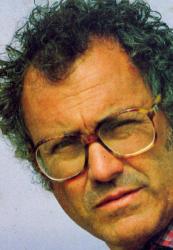
Usif Chemenzeminly
 Azerbaijan
Biography of Yusif Chemenzeminli
Yusif Vezir Chemenzeminli was an Azerbaijani writer, publicist, playwright, historian, folklorist, and political activist. He was born on September 12, 1887, in the city of Shusha, in the family of Meshedi Mirbaba bey Vezirov and Seyid Aziza khanum. The Vezir surname was associated with one of the influential viziers of Karabakh Khanate, Ibrahim Khalil Khan Mirza Alimamedagi, which was passed down through generations. Yusif's father was fluent in Persian and Turkish languages, had knowledge of literature (he loved Ferdowsi and Fuzuli), taught mugham, and traveled to many Eastern countries.
Yusif received his primary education at Molla Mehti School, known under the pseudonym "Kar Khalifa". He then continued his studies at the Russian school in the city of Agdam after spending a year there, he returned to Shusha and enrolled in the Real School, which was considered one of the best secondary educational institutions in the Caucasus at that time. In school, he showed more interest in biographies of artists and sculptors and struggled in mathematics, resulting in repeating the second year. From a young age, he engaged in drawing, starting with paintings and then moving on to drawing socio-political caricatures. As he grew older, he gained access to his older brother's library, where he began reading and was introduced to classics of Russian and foreign literature. While studying at Shusha Real School, he wrote his first poem "Complaint" in Russian. Yusif Vezir showed several of his poems to his Russian language teacher, Klemiyu. The teacher, after reading the poems, advised him to read Chekhov. Yusif was greatly impressed by Chekhov's satirical stories, which influenced his development as a writer of short stories. While studying at Shusha Real School, he co-published a monthly humorous journal in Russian called "Fokusnik" with his cousin Mir-Gasan Vezirov (one of the 26 Baku commissars). Although it was small in volume, the content was quite serious.
Early Life and Challenges
After the bloody events of 1905 in Shusha during the Armenian-Azerbaijani massacre, which was fueled by Armenian Dashnaks' propaganda and supported by the Russian Empire, Yusif's father passed away after a long illness, leaving the burden of supporting the family on the shoulders of 19-year-old Yusif. After selling their father's property in Agdam, Yusif Vezir fell ill upon returning to Shusha. During his long illness, their neighbors, three brothers from South Azerbaijan who were once sheltered by Yusif's father Meshedi Mirbaba, helped the family. After three months of illness, Yusif recovered and made a promise that if he became a famous person in the future, he would take the pseudonym "Chemenzeminli" in honor of the village of his neighbors from South Azerbaijan. In 1907, Yusif Vezir went to Baku and enrolled in Baku Real School. In 1911, his stories were published in the newspaper "Sada" and the satirical journal "Molla Nasreddin".
After graduating from Baku Real School in 1909, Yusif Vezir went to St. Petersburg and applied to the Institute of Civil Engineers. However, realizing that he would not pass the mathematics exam, he withdrew his application. In St. Petersburg, he wrote his famous story "Ticket to Paradise" and a poem dedicated to the national hero of Dagestan, Shamil. In 1910, Chemenzeminli entered the law faculty of the Imperial University of St. Vladimir in Kyiv. Throughout his studies, he maintained close ties with Azerbaijan. During these years, Yusif Vezir was frequently published in newspapers and journals published in his homeland. It was during this period that his works such as "The Actual Situation of Azerbaijani Muslim Women," "Bloody Tears," and "Mother and Motherhood" were released. Later, he wrote articles such as "Azerbaijani Autonomy," "Who We Are and What We Want?", "History of Lithuanian Tatars," "Our Foreign Policy," "Problems of Our Nation and Culture," and so on.
Due to World War I, the Tsarist government relocated Kyiv University to Saratov in 1915. After completing his university education, Yusif Vezir found work as a judge in the Saratov Court of Justice. Due to a lack of means for sustenance, he returned to Kyiv. There, he joined the "Zemstvo" organization and went to the front lines. During the February Revolution, Yusif Vezir was in Galicia. He described the events of those times in his novels "Students" and "In the Year 1917". In 1917, Yusif Vezir returned from Galicia to Kyiv. Here, he gathered Azerbaijani students around him and established an Azerbaijani society, of which he was elected chairman. After the establishment of the independent Ukrainian People's Republic, Yusif Vezir Chemenzeminli was appointed the diplomatic representative of the young Azerbaijan Democratic Republic (ADR) in Ukraine. He also served as the ADR's diplomatic representative in Crimea and Poland. The main goal of the diplomatic representation was to introduce Russian society to Azerbaijan. Therefore, they organized evenings, published articles in newspapers and magazines about the history, literature, culture, trade, and economy of Azerbaijan. Thus, Russian society gradually became acquainted with Azerbaijan.
In 1918, due to the Civil War, communication with Azerbaijan was interrupted. Yusif Vezir went to Simferopol, where he had to stay for several months. There, he found work as an advisor at the Ministry of Justice. His article "Azerbaijan and Azerbaijanis" was published in the Crimean newspaper "Millat", and in 1919, his book "Lithuanian Tatars" was released. Upon returning to his homeland, he published a series of articles in the newspaper "Azerbaijan" titled "Our Foreign Policy" and "Our National and Cultural Issues".
Later Years and Legacy
After some time, at the invitation of the Prime Minister of the Azerbaijan Democratic Republic (ADR), Nasibbey Usubbekov, Yusif Vezir went to Istanbul as an ambassador for the ADR. While engaged in diplomatic affairs in Istanbul, he continued his literary activities and in 1921, his books "A View on Azerbaijani Literature" and "Azerbaijan - Historical, Geographical, and Economic" were published, which were filled with the writer's scientific observations.
After the establishment of Soviet rule in Azerbaijan, Yusif Vezir declared the cessation of his activities. He went to Paris to be with his younger brother, Mirabdulla, who was studying at the Faculty of Diplomacy at the Paris Institute of Political Studies. Due to the inability to work as a lawyer in France, he worked as a laborer at locomotive and automobile factories in the town of Clishe near Paris. He also collaborated with the newspaper "Paris Novosti", where he published his articles under the title "Eastern Letters". After his younger brother's unexpected illness and death, Yusif Vezir decided to return to his homeland at all costs. He wrote letters to the representatives of the Soviets in Paris and Gazanfar Musabekov, the People's Commissar of the Azerbaijan Soviet Republic. Chairman of the Azerbaijan Communist Party, Kirov, welcomed Yusif Vezir's desire to return. In 1926, Yusif Vezir returned permanently from exile to his homeland.
Upon his return, Yusif Vezir worked as the editor of the artistic department at the "Bakinsky Rabochy" publishing house, and then in the socio-cultural department of the State Planning Committee, while also teaching. He first taught at the Oriental Studies and Pedagogy Faculty of Azerbaijan State University, and later at the Azerbaijani and Russian language faculties at the Pedagogical, Medical, and Oil Institutes. Simultaneously, Yusif Vezir was one of the editors of the "Russian-Azerbaijani Dictionary" edited by Ruhulla Akhundov. From 1930 to 1935, he published his novels "The Maiden's Spring," "Students," and "In the Year 1917," and wrote the comedic play "Hazrati Shahriyar".
Yusif Vezir also worked on translations. He translated works by Leo Tolstoy, Ivan Turgenev, Anton Chekhov, Nikolai Gogol, Victor Hugo, and others from Russian to Azerbaijani. In 1937, he completed his historical novel "Between Two Fires", but it was not published during his lifetime. The novel was published with abridgments in the magazine "Azerbaijan" only in 1960 under the title "In Blood". Just 3-4 months before being expelled from the Union of Azerbaijani Writers, Yusif Vezir submitted the screenplay of his work "Altunsach" to "Azerfilm". Although the work was approved by the management of "Azerfilm," the contract was never signed due to criticism of his novel "Students".
In 1937, Yusif Vezir was suspended from work under various pretexts. In 1940, he was convicted and sent to a labor camp in the Gorky region, to the station Suhobezvodnoye, where he passed away in 1943.